

If you have ever typed a sentence and stopped to wonder should it be “taken” or “taking”? you are not alone. These two words come from the same verb, but they work in completely different ways. Mixing them up is one of the most common grammar mistakes English learners make. The good news is that the rule behind taken vs taking is simple once you see it clearly. This article breaks down every detail grammar rules, sentence examples, tables, expressions, and a self-test so you walk away with full confidence in choosing the right word every time.
Both “taken” and “taking” are forms of the irregular verb “take.” Their difference comes down to tense, function, and sentence structure. “Taking” describes an action that is currently happening or in progress, while “taken” describes an action that is already finished. Once you understand how auxiliary verbs signal which form to use, the confusion disappears completely. Whether you are preparing for an English exam, writing a professional email, or just improving your daily communication, this guide on taken vs taking gives you everything you need.
Taken vs Taking: The Core Difference
Here is the short answer before we go deeper:
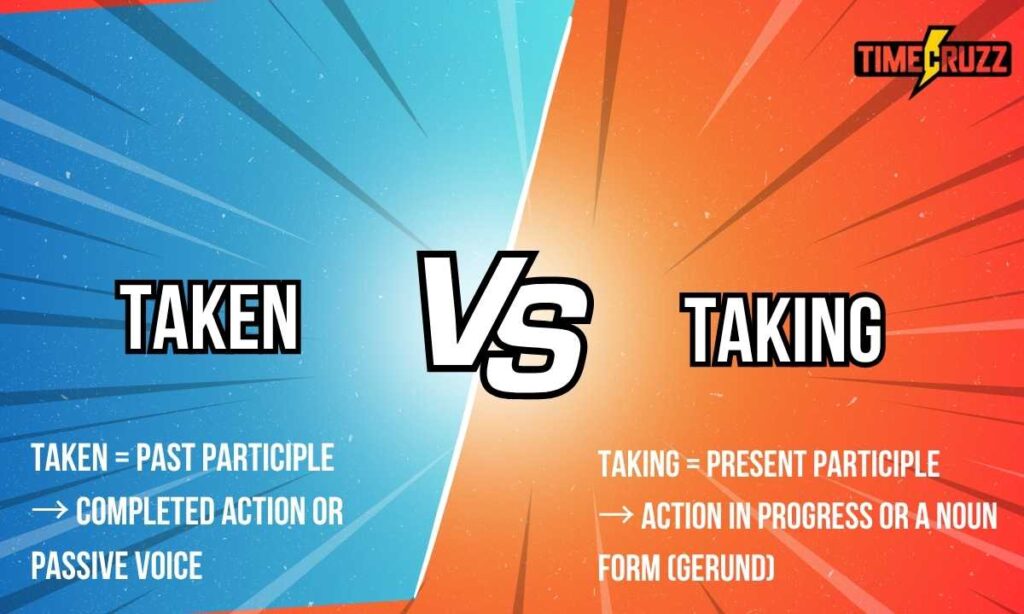
- Taking = present participle → action in progress or a noun form (gerund)
- Taken = past participle → completed action or passive voice
Taken vs taking is not about meaning. Both words come from the verb “take” and carry the same general idea. The difference is purely about grammar specifically, when the action happens and how the verb functions in a sentence.
| Word | Type | Use |
| Taking | Present participle | Ongoing action / gerund |
| Taken | Past participle | Completed action / passive voice |
Understanding the Verb “Take”
Before comparing the two forms, it helps to understand what “take” means and how it changes across tenses.
Meaning of “Take”
The verb “take” is one of the most versatile action verbs in English. Depending on the context, it can mean:
- To grab or hold something physically: Take the book.
- To accept or receive: She will take the offer.
- To travel by a method: He takes the bus every day.
- To require time or effort: It takes patience to learn a language.
- To capture or win: The team took the championship.
Because “take” is used in so many ways, its different forms taken and taking appear constantly in everyday English.
Forms of “Take”
“Take” is an irregular verb, which means it does not follow the standard “-ed” rule in the past tense. Here are all five forms:
| Form | Word | Example |
| Base form | take | I take notes every day. |
| Third-person singular | takes | She takes her medication in the morning. |
| Simple past | took | He took the wrong road. |
| Past participle | taken | They have taken the keys. |
| Present participle | taking | We are taking a break. |
“Took” is simple past it stands alone. “Taken” and “taking” are participles they always work alongside helper verbs
Quick Summary of Grammatical Functions
| Form | Helper Verbs Used With | Sentence Type |
| Taking | am, is, are, was, were, will be | Continuous (progressive) tenses |
| Taking | none (acts as a noun) | Gerund sentences |
| Taken | have, has, had | Perfect tenses |
| Taken | am, is, are, was, were, been | Passive voice |
Taken vs Taking
Now let us go through each form in full detail.
Understanding Participles and Gerunds
A participle is a verb form that helps build tenses or act as a modifier. English has two participles:
- Present participle always ends in -ing → describes ongoing action
- Past participle irregular in many verbs → describes completed action
A gerund is a present participle used as a noun. It looks like a verb but functions as the subject or object of a sentence. For example: Taking notes helps you remember more. Here, “taking” is not describing an action in progress it is the subject of the sentence, working as a noun.
This distinction is important when comparing taken vs taking, because “taking” can serve two different roles while “taken” is limited to one. Think of it this way: if you can swap the word with a regular noun like “swimming” or “reading” and the sentence still works, you are dealing with a gerund. If the word is carrying the weight of a tense alongside a helper verb, it is a participle doing its job in a verb phrase.
When to Use “Taking”
Use “taking” in two main situations:
- When describing an action currently in progress (continuous tenses)
- When using the verb as a noun (gerund)
ALSO READ THIS: Sweet vs Sweat: Differences and Never Confuse Them Again
“Taking” in Continuous (Progressive) Tenses
Continuous tenses describe actions that are ongoing happening right now, happening at a specific point in the past, or planned to continue into the future. The structure is always:
Helper verb (be) + taking
| Tense | Structure | Example |
| Present continuous | am/is/are + taking | She is taking a shower. |
| Past continuous | was/were + taking | They were taking notes during the lecture. |
| Future continuous | will be + taking | I will be taking an exam tomorrow. |
| Present perfect continuous | have/has been + taking | He has been taking piano lessons for a year. |
Tip: If you can naturally add “right now” or “at that moment” to the sentence and it still makes sense, you likely need “taking.”
“Taking” as a Gerund (Noun Form)
When “taking” acts as a noun, it is called a gerund. It can appear as the subject, object, or complement of a sentence.
- Taking risks is part of success. (subject)
- He enjoys taking long walks. (object)
- The hardest part was taking that first step. (complement)
A useful test: if you can replace the word with “this activity” and the sentence still makes sense, it is a gerund.
Common Expressions with “Taking”
English has many fixed phrases that use “taking”:
- Taking charge She is taking charge of the situation.
- Taking part He is taking part in the competition.
- Taking responsibility They are taking responsibility for the error.
- Taking a toll The long hours are taking a toll on her health.
- Taking turns The children are taking turns on the swing.
- Taking care of She is taking care of her elderly mother.
- Taking place The concert is taking place this Friday.
Quick Reference Table for “Taking”
| Function | Structure | Example |
| Present continuous | is/are + taking | He is taking a test. |
| Past continuous | was/were + taking | She was taking a nap. |
| Future continuous | will be + taking | We will be taking the train. |
| Gerund (subject) | Taking + verb | Taking risks builds courage. |
| Gerund (object) | verb + taking | She loves taking photos. |
Common Prepositions Used with Taken and Taking
Prepositions often appear alongside both forms, but the patterns differ.
With “taking”:
- She is thinking about taking a new course.
- He is interested in taking up cycling.
- They are committed to taking action.
With “taken”:
- The decision was taken without warning.
- The keys were taken from the desk.
- He was taken by surprise.
- She was taken aback by the news.
Active vs. Passive Voice with Taken and Taking
This is one area where taken vs taking becomes very clear.
Active voice places the focus on who does the action. “Taking” is used in active continuous sentences:
- She is taking the exam. (She is doing it actively.)
Passive voice places the focus on what receives the action. “Taken” is always used in passive constructions:
- The exam is being taken. (Focus on the exam, not the person.)
- The keys were taken. (We do not know who took them.)
- The photo was taken yesterday. (The photo received the action.)
“Taking” is almost never used in passive voice. If a sentence is passive, “taken” is almost certainly the correct choice.
Common Expressions with “Taken”
“Taken” appears in many common English phrases, especially in passive and figurative contexts:
- Taken for granted She felt taken for granted at work.
- Taken aback He was taken aback by her response.
- Taken ill She was suddenly taken ill.
- Taken by surprise We were taken by surprise by the announcement.
- Taken care of Everything has been taken care of.
- Taken place The meeting has taken place already.
- Taken seriously Her concerns were taken seriously by the board.
Quick Reference Table for “Taken”
| Function | Structure | Example |
| Present perfect | have/has + taken | She has taken the medicine. |
| Past perfect | had + taken | He had taken the wrong exit. |
| Future perfect | will have + taken | By noon, they will have taken a decision. |
| Passive voice | was/were + taken | The car was taken without permission. |
| Passive (present) | is/are + taken | All the seats are taken. |
When to Use “Taken”
“Taken” in Perfect Tenses
Perfect tenses connect the past to the present or earlier points in time. “Taken” always pairs with a form of “have” in perfect constructions.
| Tense | Structure | Example |
| Present perfect | have/has + taken | I have taken my vitamins. |
| Past perfect | had + taken | She had taken the wrong road before she noticed. |
| Future perfect | will have + taken | By Friday, he will have taken all his exams. |
Remember: You can never say “have taking.” The correct form in all perfect tenses is always “have/has/had + taken.”
“Taken” in the Passive Voice
Passive sentences highlight what happened to the subject, not who did it. “Taken” works with any form of “be” in passive constructions:
- The report was taken seriously. (past passive)
- The suspect has been taken into custody. (present perfect passive)
- The decision is being taken now. (present continuous passive)
Comparing “Taken” vs “Taking”
Common Confusions
Many learners write “have taking” or “is taken” by mistake. Here is a side-by-side look at the most frequent errors:
| Incorrect | Correct | Why |
| I have taking the test. | I have taken the test. | Perfect tense needs past participle. |
| She is taken a walk. | She is taking a walk. | Continuous tense needs present participle. |
| The seat is taking. | The seat is taken. | Passive voice needs past participle. |
| Taking care of it is been done. | It has been taken care of. | Perfect passive needs “taken.” |
Tricky Pairs Explained

“Taking place” vs “Taken place”
- The ceremony is taking place right now. → ongoing event
- The ceremony has taken place. → finished event
“Taking care of” vs “Taken care of”
- She is taking care of the problem. → in progress
- The problem has been taken care of. → finished
“Taking” vs “Taken” after “is”
- She is taking a class. → active, ongoing
- That seat is taken. → passive, completed state
Taken vs Taking: A Side-by-Side Comparison
Still unsure? Here is the clearest possible breakdown of taken vs taking in a single table:
| Feature | Taking | Taken |
| Type | Present participle / Gerund | Past participle |
| Signals ongoing action? | Yes | No |
| Can act as a noun? | Yes | No |
| Needs a helper verb? | Only in continuous tenses | Always |
| Used in passive voice? | Rarely | Yes, always |
| Used with have/has/had? | No | Yes |
| Used with am/is/are? | Yes (ongoing) | Yes (passive only) |
When you see taken vs taking written out like this, the pattern becomes much easier to internalize. Ongoing action = taking. Finished action or passive = taken.
Real English in Action
Seeing grammar in real sentences is one of the fastest ways to make rules stick. The examples below come from everyday situations work, school, travel, and daily life. Reading them out loud helps your ear get used to how each form naturally sounds.
- She has already taken her medication for the day.
- He is taking the last bus home tonight.
- Taking notes during lectures really does help with memory.
- The files were taken from the cabinet without permission.
- We have taken every precaution to ensure safety.
- Are you taking a language course this semester?
- The photo was taken at sunrise on the beach.
- I enjoy taking long walks on Sunday mornings.
- She was taken aback by the sudden change in plan.
- They are taking over the company next quarter.
Notice how each sentence either has a clear helper verb pointing to the right form, or the word acts as a noun at the start of the sentence. That pattern repeats in almost every case you will encounter in natural English.
Quick Grammar Hacks to Remember
These mental shortcuts help you pick the right form instantly:
- See “have,” “has,” or “had”? → Use taken. Example: She has ____ the medicine. → She has taken the medicine.
- See “am,” “is,” “are,” “was,” or “were” describing ongoing action? → Use taking. Example: He is ____ a walk. → He is taking a walk.
- Does the word act as a noun (subject or object)? → Use taking. Example: ____ a break improves focus. → Taking a break improves focus.
- Is the sentence passive? → Use taken. Example: The book was ____. → The book was taken.
- Can you say “right now” and it makes sense? → Use taking. Example: She is studying right now. = She is taking notes right now.
Common Mistakes to Avoid
Here are the errors that appear most often when learners write taken vs taking:
- Writing “have taking” Never correct. Perfect tenses always need “taken,” not “taking.”
- Writing “is taken” for an active ongoing action If someone is currently doing something, use “is taking,” not “is taken.”
- Forgetting that “taken” needs a helper verb “Taken” cannot stand alone as the main verb. You cannot say “She taken the book.” You must say “She has taken the book.”
- Using “taking” in passive sentences Passive voice requires “taken,” not “taking.” Say “The picture was taken,” not “The picture was taking.”
- Confusing “took” and “taken” “Took” is simple past and stands alone. “Taken” is past participle and always needs a helper verb.
A good habit is to read your sentence back to yourself slowly after writing it. Ask: is the action finished, or is it still going on? That one question will catch most errors before they make it into your final draft. Native speakers rarely think about these rules consciously they just feel what sounds right. With regular practice, you will reach that same level of instinct.
Examples Section: Taken vs Taking in Sentences
“Taking” examples:
- She is taking a yoga class on Monday evenings.
- They were taking a break when the alarm went off.
- Taking care of your mental health is just as important as physical health.
- I will be taking the train to the city tomorrow.
- Taking risks without a plan is not the same as being brave.
“Taken” examples:
- He has taken his seat at the front of the room.
- All the available slots have been taken.
- She was taken by surprise when her name was called.
- The decision was taken by the board after a long discussion.
- Had I taken the earlier flight, I would have arrived on time.
Mixed examples showing the contrast:
- She is taking the exam right now. / She has taken the exam already.
- He was taking notes. / His notes were taken seriously.
- Taking a break helps. / I have taken a short break.
Self Assessment: Test Yourself
Fill in the blank with either “taken” or “taking”:
- She has ______ her medication this morning.
- They are ______ a trip to Japan next week.
- ______ breaks during study sessions improves concentration.
- All the parking spots were ______ by the time we arrived.
- I will be ______ an online course starting Monday.
- He had ______ the wrong exit before realizing his mistake.
- The photographs were ______ during the golden hour.
- ______ responsibility is a sign of maturity.
- The company has ______ steps to reduce its carbon footprint.
- She was ______ care of her younger siblings after school.
Self Assessment Answers
- taken (present perfect has + taken)
- taking (present continuous are + taking)
- Taking (gerund acts as the subject)
- taken (passive were + taken)
- taking (future continuous will be + taking)
- taken (past perfect had + taken)
- taken (passive were + taken)
- Taking (gerund acts as the subject)
- taken (present perfect has + taken)
- taking (past continuous was + taking)
Conclusion
Understanding taken vs taking comes down to one key idea: time and completion. If the action is still in progress or you are using the verb as a noun, choose “taking.” If the action is already done or the sentence is passive, choose “taken.” Keep an eye on the helper verb before the blank it gives the answer almost every time. The more you practice spotting these patterns in real conversations and writing, the faster the right choice becomes second nature.
The grammar behind taken vs taking is not complicated once the structure is clear. Start by checking the auxiliary verb in any sentence you write. Use “have/has/had” → taken. Use “am/is/are” for ongoing action → taking. Apply this in your daily writing, and your confidence in English grammar will grow steadily. The goal is not to memorize rules mechanically it is to recognize patterns naturally, the way fluent speakers do.

I’m Daniel James, creator of TimeCruzz. I share simple grammar tips and writing guides to help learners improve English skills quickly, clearly, and confidently through easy explanations and practical examples.