


You have probably typed it a hundred times without thinking twice. But when you stop and look at it, the question hits: is it of course or ofcourse? It is a small detail, but it shows up in emails, essays, business reports, and everyday texts. Getting it wrong can make your writing look careless, even when everything else is well-written.
This guide clears up the confusion once and for all. You will learn the correct spelling, why the mistake happens so often, how “of course” works in different contexts, and how to remember the right form every single time.
Of Course or Ofcourse: What Writers Should Know
The answer is simple: “of course” is always correct. “Ofcourse” is always wrong. No standard English dictionary, grammar guide, or style manual accepts “ofcourse” as a valid word or phrase. It is a misspelling, nothing more.
This distinction matters more than many writers realize. Whether you are drafting a professional email, writing an academic paper, or posting content online, the correct form is two separate words: of course.
Why People Get Confused About “ofcourse or of course”?
The confusion is understandable. Here are the most common reasons it happens:
Phonetic Blending
When people say “of course” in natural conversation, the two words blend together seamlessly. The gap between “of” and “course” disappears in fast speech, which makes the brain assume the spelling should match what the ear hears one continuous unit.
Texting and Informal Writing
Texting culture thrives on speed. People shorten words, skip punctuation, and merge phrases without thinking. The abbreviation “ofc” is widely used in chats, which reinforces the idea that “ofcourse” as one word is acceptable. It is not in standard English.
Compound Word Assumptions
English does have many compound words: notebook, fireplace, sunshine. Seeing two words used together frequently leads some writers to assume they should merge into one. But “of course” never follows that rule. It remains a prepositional phrase, not a compound word.
Autocorrect Influence
Some phones and keyboards do not flag “ofcourse” as an error. When autocorrect stays silent, writers assume the spelling is fine. This is one case where you cannot rely on technology to catch the mistake you need to know the rule yourself.
The Correct Spelling: “Of Course”
Meaning
“Of course” is a prepositional phrase built from two distinct parts: of (a preposition) and course (a noun). Together, they form an expression that conveys certainty, agreement, or the idea that something is obvious or expected. The word “course” traces back to the Latin cursus, meaning “a running” or a natural path the idea being that something follows the natural order of things.
How “Of Course” Functions in Sentences
“Of course” is flexible. It can appear at the beginning, middle, or end of a sentence. When placed mid-sentence, it is typically set off by commas to show it refers to the surrounding clause.
- Beginning: Of course, I will send you the report.
- Middle: She was, of course, the best candidate.
- End: He agreed to help, of course.
It functions as a discourse marker it signals tone, agreement, or emphasis rather than carrying its own subject or verb.
Using “Of Course” in Formal Writing
“Of course” fits naturally in formal writing when used appropriately. It works well in business emails, academic papers, and professional reports. The key is to avoid overusing it, as it can start to feel like filler if it appears in every other sentence.
According to Cambridge Dictionary, “of course” is used to refer to things that are obvious or already known to both the speaker and listener. It is not appropriate when you are sharing new information the listener does not already know.
When the Phrase Works Best
- To give polite permission: Of course, you may leave early today.
- To express strong agreement: “Can you finish by Friday?” — “Of course.”
- To acknowledge something obvious: The project took longer — there were, of course, unexpected delays.
- To soften a statement: You should, of course, check with your manager first.
The Incorrect Spelling: “Ofcourse”
Why “Ofcourse” Is Wrong
“Of” is a preposition. “Course” is a noun. A preposition and a noun do not merge into a single compound word in English grammar they remain separate to show their grammatical relationship. The AP Stylebook confirms that words should only be grouped when they are commonly hyphenated and modify another noun or verb. “Ofcourse” does not meet that standard. There is no dictionary or grammar authority that lists it as correct.
Examples of Incorrect Usage
- ❌ Ofcourse I can help you with that.
- ❌ She was ofcourse the first to arrive.
- ❌ Ofcourse, we need to review the contract.
Corrected Versions
- ✅ Of course I can help you with that.
- ✅ She was, of course, the first to arrive.
- ✅ Of course, we need to review the contract.
Why Search Engines Auto-Correct It
Google and other search engines recognize “ofcourse” as a likely misspelling and often auto-suggest “of course” instead. This tells you something important: even algorithms trained on billions of web pages do not treat “ofcourse” as a valid term. Search engines use spelling correction because user intent almost always points to the two-word version.
Commonly Confused Variations of “Of Course”
“Offcourse” — Another Incorrect Form
“Offcourse” is another misspelling that occasionally appears. It is not a real word. It is simply a confused blend of “of course” and “off course.” Avoid it entirely.
“Off Course” — A Completely Different Meaning
Definition
“Off course” (with two f’s) is a legitimate phrase, but it means something entirely different. It describes a deviation from a planned route or direction. A ship, aircraft, or person who is “off course” is no longer following the intended path.
Examples
- The flight went off course due to a storm.
- Without a clear plan, the project went off course quickly.
- The hiker realized she was off course after two hours.
Notice that “off course” is about direction and deviation, while “of course” is about agreement and certainty. These two phrases are not interchangeable.
Side-by-Side Comparison Table
| Form | Correct? | Meaning | Example |
| of course | ✅ Yes | Agreement, certainty, or something obvious | Of course, I’ll attend the meeting. |
| ofcourse | ❌ No | Not a word in standard English | — |
| off course | ✅ Yes | Deviating from a planned path or direction | The ship went off course. |
| offcourse | ❌ No | Not a word in standard English | — |
How to Remember the Correct Spelling

Mnemonic Tricks
The simplest trick is to think of the phrase in reverse: “course of.” You would never write “courseOf” as one word — and that same logic applies going forward. The two words stay separate, always.
Another approach: remember that “of” is a preposition. Prepositions in English are always standalone words. You would not write “inthe house” instead of “in the house.” The same rule applies here: “of course,” not “ofcourse.”
Word Association
Associate “of course” with other prepositional phrases you already know: in time, at ease, of course. All of them are two words. Seeing the pattern makes it easier to remember.
Case Study: How Memory Tricks Helped Writers
A content team at a mid-sized digital agency noticed their writers were consistently writing “ofcourse” in drafts. After a team lead introduced the simple rule — prepositions are always separate — the error rate dropped significantly within two weeks. The lesson: a clear, logical rule sticks better than just memorizing a spelling.
Synonyms and Alternatives to “Of Course”
If “of course” feels repetitive, these alternatives carry the same meaning with different tones.
Formal Alternatives
- Certainly
- Naturally
- Indeed
- Without question
- Absolutely
Neutral Everyday Alternatives
- Sure
- Definitely
- By all means
- No doubt
Casual Alternatives
- Obviously
- Sure thing
- Totally
- Yeah, definitely
Context Table for Synonyms
| Context | Best Alternatives |
| Business email | Certainly, Absolutely, Of course |
| Academic writing | Indeed, Naturally, Without question |
| Casual conversation | Sure, Totally, Definitely |
| Giving permission | By all means, Of course, Certainly |
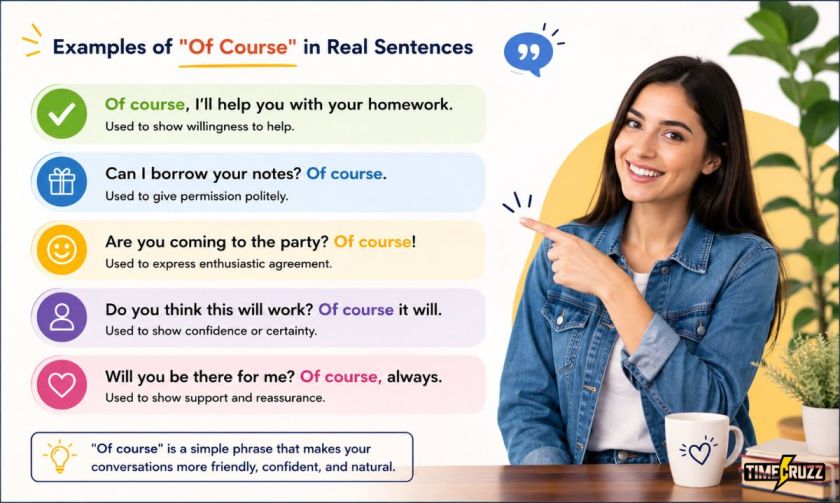
Examples of “Of Course” in Real Sentences
Conversational Use
- “Are you coming to the party?” — “Of course!”
- Of course I remember you — we met at the conference last year.
- She will help, of course. She always does.
Professional Use
- Of course, we will deliver the project by the agreed deadline.
- Please let us know if you need anything else — of course, we are happy to assist.
- The terms were, of course, reviewed by legal before signing.
Softening a Statement
- You should, of course, consult a specialist before making any decisions.
- This is, of course, just one perspective.
- Of course, your feedback is always welcome.
Contrasting With Incorrect Forms
| Incorrect | Correct |
| Ofcourse, I agree with you. | Of course, I agree with you. |
| She was ofcourse the last to know. | She was, of course, the last to know. |
| Ofcourse you can join us. | Of course you can join us. |
Quote Example
As Cambridge Dictionary explains, “of course” is used when a situation or piece of information is not surprising — it marks shared understanding between speaker and listener. This is exactly what makes it so useful in both spoken and written English.
Quick Reference Summary Table
| Question | Answer |
| Correct spelling | of course (two words) |
| Incorrect spelling | ofcourse (never use) |
| Part of speech | Prepositional phrase / discourse marker |
| Meaning | Certainty, agreement, or something obvious |
| Use in formal writing? | Yes, it is appropriate and professional |
| Is “off course” the same? | No — it means deviating from a path |
| Is “offcourse” correct? | No — not a real word |
| Comma needed? | Yes, when used mid-sentence |
| Formal synonyms | Certainly, Naturally, Indeed |
| Casual synonyms | Sure, Totally, Definitely |
Frequently Asked Questions
Is “ofcourse” ever acceptable in English?
No. “Ofcourse” is a misspelling and is not accepted in standard English, formal or informal.
Should “of course” have a comma after it?
Yes, when it starts a sentence or is used mid-sentence, commas improve clarity and follow standard grammar rules.
What is the difference between “of course” and “off course”?
“Of course” means certainty or agreement; “off course” means deviating from a planned route they are completely different phrases.
Can “of course” be used in formal writing?
Yes, “of course” is appropriate in formal writing when expressing agreement, giving permission, or highlighting something already understood.
What is a good synonym for “of course” in business emails?
“Certainly” and “absolutely” are both strong, professional alternatives to “of course” in business communication.
Conclusion
The difference between “of course” and “ofcourse” comes down to one simple rule: the correct form is always two words. “Ofcourse” is a misspelling that appears in casual texts and informal posts, but it has no place in proper writing. Whether you are sending a professional email, writing an essay, or publishing content online, “of course” is the only version that belongs.
Keep this rule close: “of” is a preposition and prepositions stand alone. Once that clicks, you will never second-guess this spelling again. And of course, if you are ever unsure, this guide will be here to set you straight

I’m Daniel James, creator of TimeCruzz. I share simple grammar tips and writing guides to help learners improve English skills quickly, clearly, and confidently through easy explanations and practical examples.