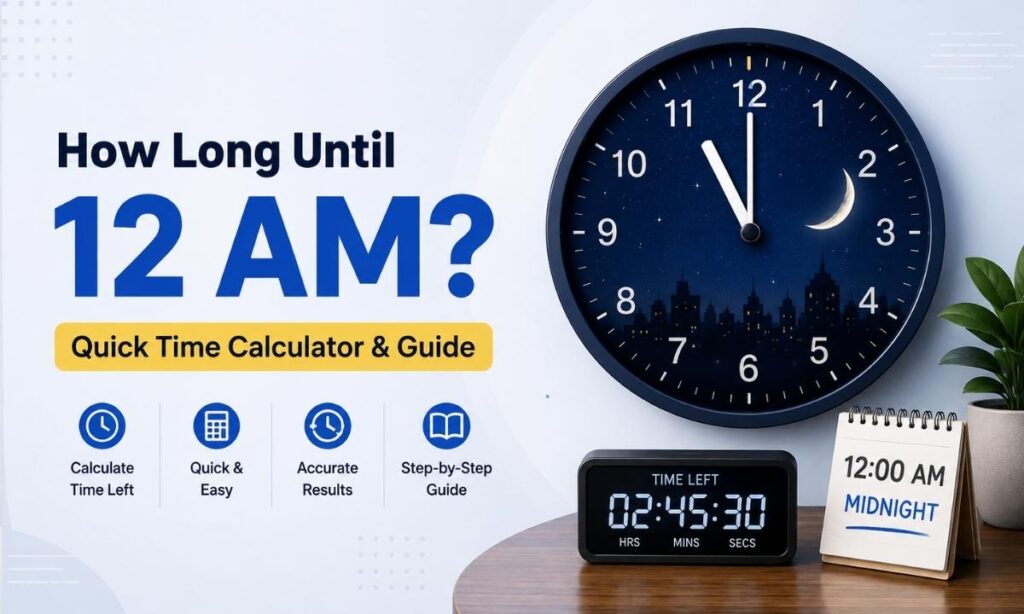

Quick answer for anyone counting down to midnight whether you’re pulling an all-nighter, waiting for a deadline, or just curious.
Ever found yourself glancing at the clock, wondering exactly how much time stands between right now and midnight? You’re not alone. This is one of those questions people search constantly usually late at night, usually because something is due, starting, or ending at 12 AM.
This guide breaks down exactly how to calculate the time remaining until midnight, no matter what time it currently is, plus practical examples and a few shortcuts you can use without doing math in your head.
Quick Answer
To find out how long until 12 AM, subtract the current time from 24:00 (midnight in 24-hour format). For example, if it’s currently 9:00 PM, you have 3 hours left until midnight. If it’s 11:45 PM, you’re just 15 minutes away.
The formula is simple:
Hours until midnight = 24 – current hour (in 24-hour format)
Then adjust for minutes if the current time isn’t on the hour.
Why People Search “How Long Until 12 AM”
This isn’t just idle curiosity. People look this up for real, practical reasons:
- Deadlines Assignments, orders, or online forms that close “by midnight” tonight.
- New Year’s countdowns Especially around December 31st.
- Contest or sale endings Flash sales, ticket releases, or promo codes expiring at midnight.
- Sleep planning Figuring out how many hours are left before bed or before an alarm.
- Fasting windows People doing intermittent fasting often track eating windows that end at midnight.
- Work shifts Night shift workers calculating how much of their shift remains.
- Gaming and app resets Many mobile games and apps refresh daily quests or rewards at 12 AM.
Basically, midnight acts as a natural “reset point” for a lot of daily activities, so knowing exactly how far away it is matters more than people expect.
Step-by-Step: How to Calculate Time Until Midnight
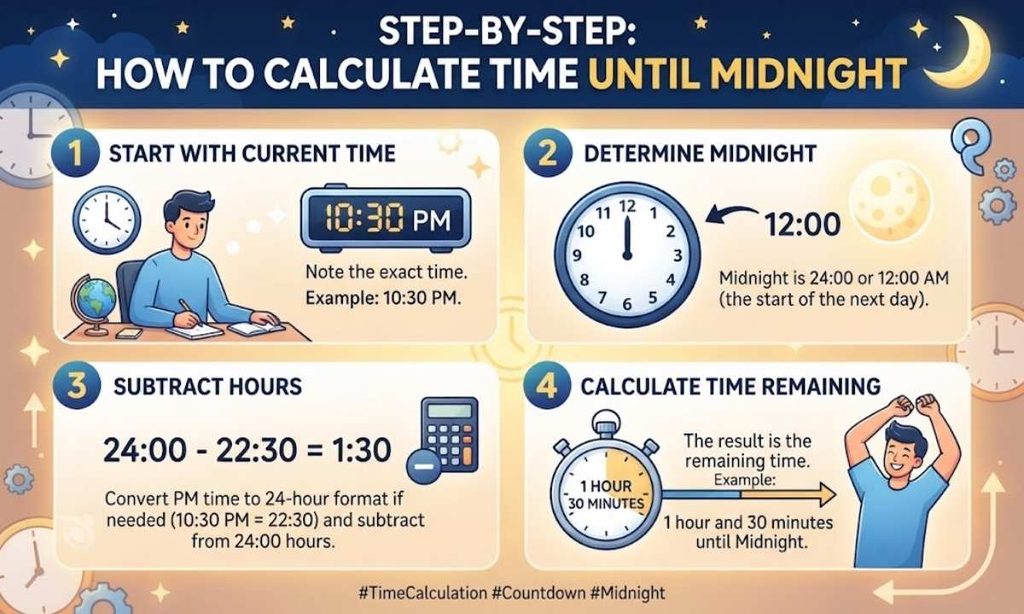
Here’s the manual method, broken into simple steps.
ALSO READ THIS: How Long Until 1:20? Here’s Exactly How to Figure It Out
Step 1: Convert Your Current Time to 24-Hour Format
If you’re using AM/PM, convert it first:
- AM times stay the same (except 12 AM becomes 00:00)
- PM times get 12 added (except 12 PM stays 12:00)
So 8:00 PM becomes 20:00. 11:30 PM becomes 23:30.
Step 2: Subtract From 24:00
Midnight is represented as 24:00 (or 00:00 the next day). Subtract your current time from 24:00.
Example: It’s 20:00 (8:00 PM). 24:00 – 20:00 = 4 hours until midnight.
Step 3: Handle the Minutes Separately
If your current time isn’t a clean hour, split the calculation:
Example: It’s 9:20 PM (21:20).
- Hours: 24 – 21 = 3 hours
- Minutes: 60 – 20 = 40 minutes
- But since you “borrowed” from the hour, subtract 1 hour: 3 – 1 = 2 hours
- Final answer: 2 hours and 40 minutes until midnight
Step 4: Double-Check With Simple Subtraction
An easier way to think about it: just count forward from your current time to 12:00 AM using a normal clock in your head. Most people find this faster than converting formats once they get the hang of it.
Time Until Midnight: Quick Reference Table
Here’s a table you can scan instead of doing the math yourself.
| Current Time | Time Until 12 AM |
| 6:00 PM | 6 hours |
| 7:00 PM | 5 hours |
| 8:00 PM | 4 hours |
| 9:00 PM | 3 hours |
| 9:30 PM | 2 hours 30 minutes |
| 10:00 PM | 2 hours |
| 10:15 PM | 1 hour 45 minutes |
| 10:30 PM | 1 hour 30 minutes |
| 11:00 PM | 1 hour |
| 11:15 PM | 45 minutes |
| 11:30 PM | 30 minutes |
| 11:45 PM | 15 minutes |
| 11:55 PM | 5 minutes |
Minute-Level Breakdown (For Precision Timing)
If you need something more exact say you’re timing a deadline down to the minute here’s a more granular table.
| Current Time | Hours Left | Minutes Left | Total Minutes Until Midnight |
| 8:47 PM | 3 | 13 | 193 |
| 9:12 PM | 2 | 48 | 168 |
| 9:58 PM | 2 | 2 | 122 |
| 10:33 PM | 1 | 27 | 87 |
| 11:06 PM | 0 | 54 | 54 |
| 11:41 PM | 0 | 19 | 19 |
This kind of breakdown is especially useful if you’re tracking something like an online checkout window or a countdown timer that needs to be accurate to the minute, not just the hour.
Real-World Application Scenarios
Scenario 1: Deadline Submission
You’re submitting an assignment that’s due “by midnight tonight.” It’s currently 7:40 PM.
- 24:00 – 19:40 = 4 hours 20 minutes remaining
That gives you a clear buffer to finish, proofread, and submit without rushing at the last second.
Scenario 2: New Year’s Eve Countdown
It’s 11:47 PM on December 31st. Everyone’s asking how long until midnight.
- 60 – 47 = 13 minutes until 12 AM
This is the classic countdown moment short, tense, and exactly why this search spikes every year around this time.
Scenario 3: Night Shift Work
Your shift started at 6:00 PM and ends at 2:00 AM. It’s currently 9:15 PM. How much time is left until midnight (the halfway marker for many shift workers)?
- 24:00 – 21:15 = 2 hours 45 minutes until midnight, with another 2 hours after that until your shift ends
Scenario 4: Fasting Window
You’re doing a fasting schedule where your eating window closes at midnight. It’s 8:05 PM.
- 24:00 – 20:05 = 3 hours 55 minutes left to eat
Common Mistakes and Misconceptions
People trip up on this more often than you’d think. Here are the usual culprits:
- Confusing 12 AM with 12 PM. 12 AM is midnight (start of the day), while 12 PM is noon. This mix-up throws off calculations constantly.
- Forgetting to convert to 24-hour format before subtracting. Trying to subtract PM times directly without converting leads to wrong answers.
- Miscounting minutes. When the current time has minutes past the hour, people forget to “borrow” an hour, leading to answers that are off by exactly one hour.
- Assuming midnight is “00:00 today” instead of “24:00 today” or “00:00 tomorrow.” Both are technically correct, but mixing the logic mid-calculation causes errors.
- Ignoring time zones. If you’re coordinating a deadline with someone in another time zone, “midnight” isn’t the same moment for both of you. Always clarify which time zone the deadline refers to.
Related Calculations You Might Also Need
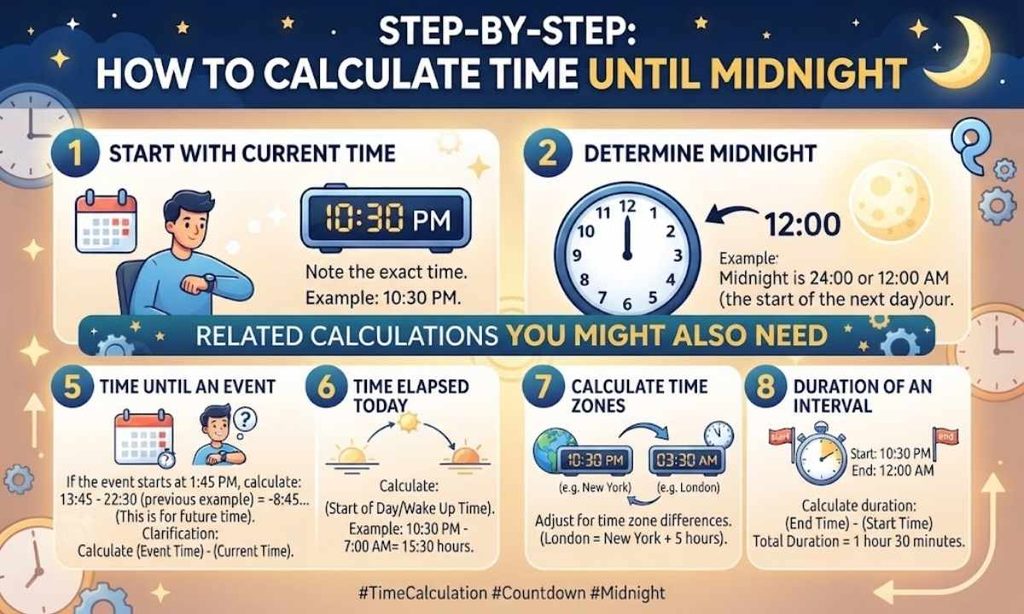
Since midnight calculations often come up alongside other time-based questions, here are a few related ones worth knowing:
- How long until 12 PM (noon) Same method, just subtract from 12:00 instead of 24:00.
- How many hours between two specific times Subtract the earlier time from the later one, converting both to 24-hour format first.
- Countdown to a specific date and time Combine both date difference and time difference calculations.
- Time zone conversions Useful when “midnight” needs to line up across different regions.
- Elapsed time calculations Figuring out how much time has passed since a starting point, rather than how much is left.
Conclusion
Figuring out how long until 12 AM really comes down to one simple idea: subtract your current time from midnight, adjusting for minutes as needed. Whether you’re racing a deadline, counting down to a new year, or just planning your evening, the math takes seconds once you know the method. Bookmark the tables above if you’d rather skip the calculation entirely and just check the clock.
Frequently Asked Questions
How many hours are there from 6 PM to 12 AM?
There are exactly 6 hours between 6:00 PM and 12:00 AM (midnight).
Is 12 AM the start or end of the day?
12 AM marks the very start of a new day, not the end of the previous one. It’s the moment the clock resets to 00:00.
How do I calculate time until midnight if it’s already past 12 AM?
If it’s already past midnight, you’re now counting toward the next midnight, which is 24 hours away from the previous one. Simply apply the same subtraction method using the new current time.
What’s the difference between 12 AM and 12 PM?
12 AM is midnight, marking the beginning of a new day. 12 PM is noon, the midpoint of the day. They’re 12 hours apart and often confused because both use “12.”
Why does my countdown app show a different time than my manual calculation?
This usually happens because of time zone settings or daylight saving time adjustments. Double-check that your device’s time zone matches the one you’re calculating for.

I’m Daniel James, creator of TimeCruzz. I share simple grammar tips and writing guides to help learners improve English skills quickly, clearly, and confidently through easy explanations and practical examples.