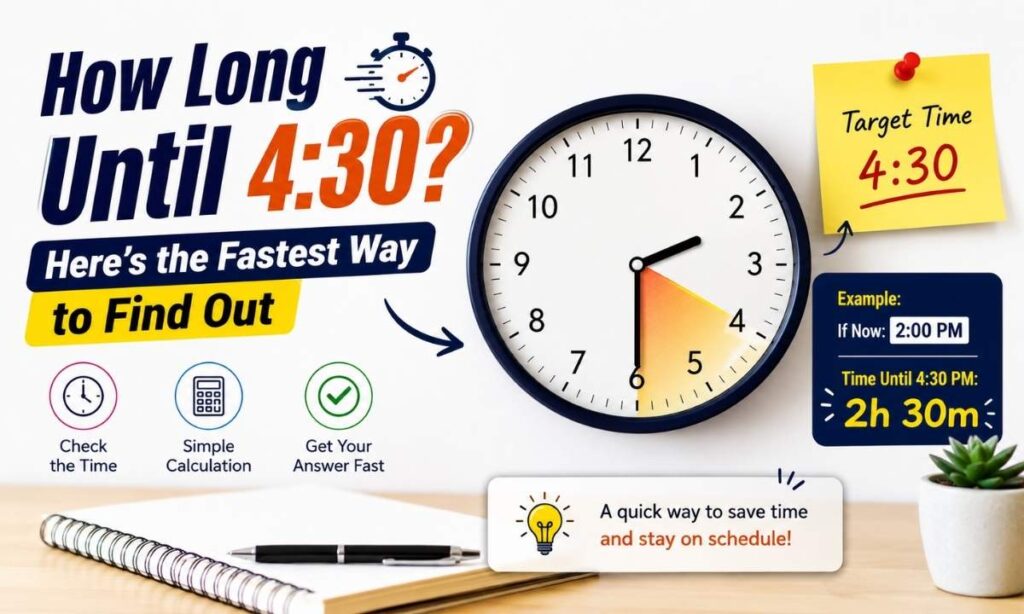

You glanced at the clock, you’ve got somewhere to be at 4:30, and now you’re doing that awkward mental math where you’re not sure if you’re counting right. Happens to everyone. This guide walks you through exactly how to figure out how long until 4:30 — whether that’s 4:30 AM or 4:30 PM — with simple formulas, real examples, and a couple of shortcuts you can use without pulling out a calculator.
Quick Answer
The time remaining until 4:30 depends entirely on what time it is right now. Here’s the basic method:
Subtract your current time from 4:30. If the current time is later in the day than 4:30 AM but earlier than 4:30 PM, you’re counting toward the afternoon slot. If it’s already past 4:30 PM, you’re counting toward 4:30 AM the next day.
The formula in its simplest form:
Time until 4:30 = 4:30 (target) − Current time
If the result is negative, add 12 or 24 hours depending on whether you’re working in 12-hour or 24-hour format, since that means your target time has already passed and you’re counting to the next occurrence.
Why This Question Trips People Up?
Most people aren’t bad at math — they’re bad at clock math specifically, because clocks don’t work in base 10. An hour has 60 minutes, not 100, so your brain wants to do decimal subtraction and gets the wrong answer. Someone asking “how long until 4:30” at 2:45 might instinctively subtract 45 from 30, panic, and just guess. There’s also the AM/PM ambiguity: “4:30” alone doesn’t tell you which one, so the answer genuinely changes based on context.
Step-by-Step: How to Calculate Time Until 4:30
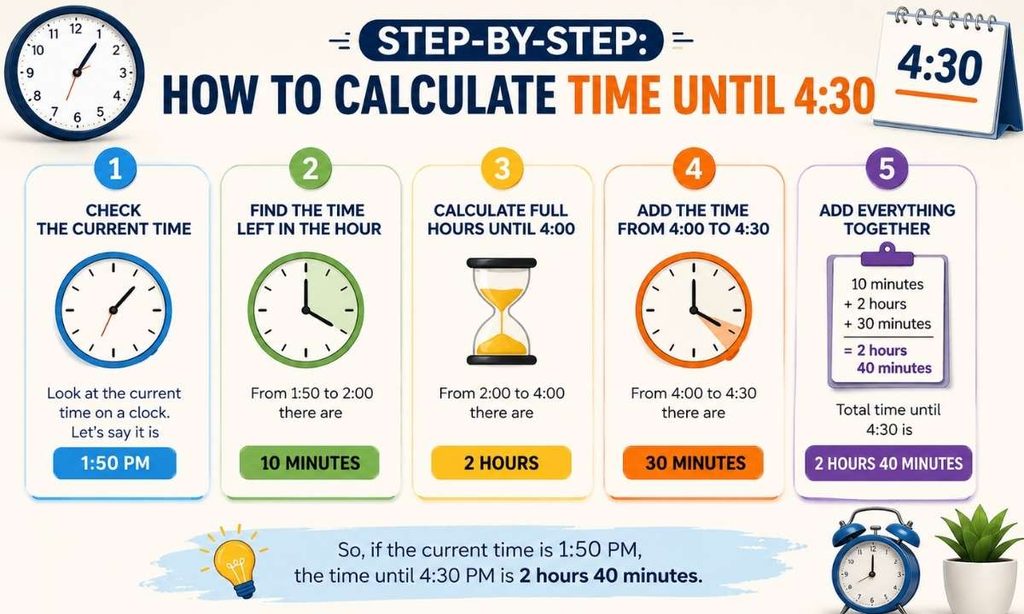
Here’s the reliable, no-guessing method.
Step 1: Identify your current time
Look at the clock and note the exact hour and minute. Let’s say it’s 1:15 PM.
Step 2: Confirm which 4:30 you mean
Decide if you’re targeting 4:30 AM or 4:30 PM. This matters because the gap is completely different depending on the answer.
Step 3: Subtract hours first
Take the target hour minus the current hour.
Example: 4:30 PM minus 1:15 PM
- 4 (hours) − 1 (hour) = 3 hours
Step 4: Subtract minutes
- 30 (minutes) − 15 (minutes) = 15 minutes
Step 5: Combine your result
3 hours + 15 minutes = 3 hours and 15 minutes until 4:30 PM
Step 6: Handle the borrowing case
If the current minutes are higher than 30 (say it’s 1:45 PM), you can’t subtract 45 from 30 directly. Borrow an hour:
- Convert 4:30 to 3:90 (borrowing 60 minutes from the hour column)
- Now subtract: 3 hours − 1 hour = 2 hours, and 90 minutes − 45 minutes = 45 minutes
- Result: 2 hours and 45 minutes
That borrowing trick is the one thing most people forget, and it’s the actual source of most wrong answers.
Example Calculations Table
Here’s a set of common starting times and how long you’d have left until 4:30 PM:
| Current Time | Time Until 4:30 PM |
| 12:00 PM | 4 hours 30 minutes |
| 1:00 PM | 3 hours 30 minutes |
| 2:15 PM | 2 hours 15 minutes |
| 3:00 PM | 1 hour 30 minutes |
| 3:45 PM | 45 minutes |
| 4:00 PM | 30 minutes |
| 4:20 PM | 10 minutes |
| 4:29 PM | 1 minute |
And here’s the same idea if your target is 4:30 AM instead:
| Current Time | Time Until 4:30 AM |
| 10:00 PM | 6 hours 30 minutes |
| 11:30 PM | 5 hours |
| 1:00 AM | 3 hours 30 minutes |
| 2:45 AM | 1 hour 45 minutes |
| 3:50 AM | 40 minutes |
| 4:15 AM | 15 minutes |
Converting Time Differences Into Other Units
Sometimes “hours and minutes” isn’t the format you need. Maybe you’re setting a countdown timer, coding a script, or just curious how it breaks down. Here’s how to convert a typical gap — let’s use 2 hours 45 minutes as the example — into other units.
| Unit | Conversion | Result |
| Minutes only | (2 × 60) + 45 | 165 minutes |
| Seconds only | 165 × 60 | 9,900 seconds |
| Decimal hours | 2 + (45 ÷ 60) | 2.75 hours |
| Fraction of a day | 165 ÷ 1440 | ~0.115 of a day |
This decimal conversion is especially useful if you’re logging hours for work, building a scheduling app, or just want a cleaner number to work with instead of “hours and minutes.”
ALSO READ THIS: How Long Until 6PM? The Simple Way to Calculate It (With Examples)
Real-World Scenarios Where This Question Comes Up

Scheduling a meeting. You’re mid-workday and someone asks to hop on a call at 4:30. You need a fast gut-check on whether that gives you enough runway to finish what you’re doing.
Waiting for an appointment. Doctor’s office, hair salon, pickup line at school — knowing you’ve got “an hour and change” versus “ten minutes” changes what you do with the wait.
Cooking or baking. Recipes sometimes tell you to have something ready by a certain time, and working backward from 4:30 tells you when to actually start.
Setting an alarm. If it’s 11:00 PM and you want to be up by 4:30 AM, you’re calculating rest time, not just a countdown — this is the version of the question insomniacs ask a lot.
Travel and commuting. If your train, flight, or ride is scheduled to arrive by 4:30, you’re often reverse-engineering when you need to leave.
Common Mistakes People Make
Forgetting AM vs PM entirely. This is the single biggest source of wrong answers. “4:30” without context is ambiguous, and guessing wrong throws off the whole calculation.
Subtracting minutes without borrowing. As shown above, if your current minutes are greater than 30, straight subtraction gives you a negative number that people often just flip to positive instead of properly borrowing an hour.
Mixing 12-hour and 24-hour formats. If your phone shows 16:30 and you’re mentally converting to “4:30,” it’s easy to lose track of whether you’ve already accounted for the PM shift.
Ignoring the day rollover. If it’s currently 6:00 PM and you’re asking about 4:30, you’re not counting backward into a negative number — you’re counting forward to 4:30 the next morning, which is a totally different math problem (10 hours 30 minutes, not negative 1.5 hours).
Rounding too early. Rounding “3 hours 47 minutes” down to “about 4 hours” is fine for a casual guess, but it’s the kind of shortcut that gets people to appointments late.
Why People Search “How Long Until 4:30”
This is one of those searches that spikes constantly throughout the day, every day, because it’s not really about the number 4:30 specifically — it’s about the general habit of checking how much time is left before something. People search variations of this for nearly every hour on the clock, but 4:30 shows up a lot because it’s a common end-of-workday marker, a common pickup time, and a common “let’s talk later” scheduling anchor. It’s less about curiosity and more about planning the next move.
Related Time Calculations You Might Need
- How long until 5:00 — the next half-hour marker, useful for end-of-day planning
- How long until midnight — common for New Year’s countdowns or late-night deadlines
- Hours between two times — useful for timesheets and shift calculations
- Time zone conversions — if your 4:30 is someone else’s different hour entirely
- Countdown to a specific date — for longer-range planning like events or trips
If you regularly need to do this kind of math, a simple digital countdown timer or a calendar app with a built-in time-difference calculator will save you the mental gymnastics entirely.
Conclusion
Figuring out how long until 4:30 really comes down to one clean subtraction — target time minus current time — with a quick check on AM versus PM and a bit of care around borrowing minutes.
Once you’ve got the method down, it takes about five seconds, no calculator needed. Whether you’re counting down to a meeting, an alarm, or just watching the clock until the workday wraps up, the steps above will get you an accurate answer every time.
FAQ’s
How do I calculate how long until 4:30 without a calculator?
Subtract your current hour from 4, then your current minutes from 30. If your minutes are higher than 30, borrow an hour first (turn 4:30 into 3:90) before subtracting.
Is 4:30 in the morning or afternoon?
It depends entirely on context. Without AM or PM specified, most people default to whichever one is closer — but always confirm, since the gap changes dramatically between the two.
What if it’s already past 4:30 PM — how long until 4:30 the next day?
Count forward to midnight, then add the hours from midnight to 4:30 AM. For example, from 6:00 PM it’s 6 hours to midnight, plus 4.5 hours to 4:30 AM, totaling 10 hours 30 minutes.
How many minutes are there until 4:30 if it’s currently 3:52?
That’s 38 minutes. Subtract 3:52 from 4:30 by borrowing an hour (4:30 becomes 3:90), then 90 − 52 = 38 minutes.
Can I set a timer instead of calculating manually?
Yes — most phones let you set an alarm for a specific clock time rather than a countdown duration, which skips the math entirely and is the easiest option if you just need a reminder.

I’m Daniel James, creator of TimeCruzz. I share simple grammar tips and writing guides to help learners improve English skills quickly, clearly, and confidently through easy explanations and practical examples.