


Trying to figure out What Time Was It 15 Hours Ago? Maybe you’re tracking a flight, checking a server log, working out a time difference with someone overseas, or just settling an argument about when something actually happened. Whatever the reason, the math is simple once you see it laid out. This guide walks you through the exact calculation, gives you ready-made tables so you don’t have to do it in your head, and clears up the mistakes people make most often.
Quick Answer: How to Find What Time It Was 15 Hours Ago
To find what time it was 15 hours ago, subtract 15 hours from your current time. If the result goes below 0:00, you roll back into the previous calendar day and add 24 to the negative hour value.
Here’s the shortcut most people actually use:
- If your current hour (in 24-hour format) is 15 or greater, just subtract 15. You’ll stay on the same day.
- If your current hour is less than 15, subtract 15, then add 24 to get the correct hour. You’ll land on the previous day.
For example, if it’s 10:00 PM today, 15 hours ago was 7:00 AM today. But if it’s 10:00 AM today, 15 hours ago was 7:00 PM yesterday.
That’s the whole trick. Everything else in this article is just examples, tables, and edge cases so you never second-guess it.
Time Calculation Table: What Time Was It 15 Hours Ago?
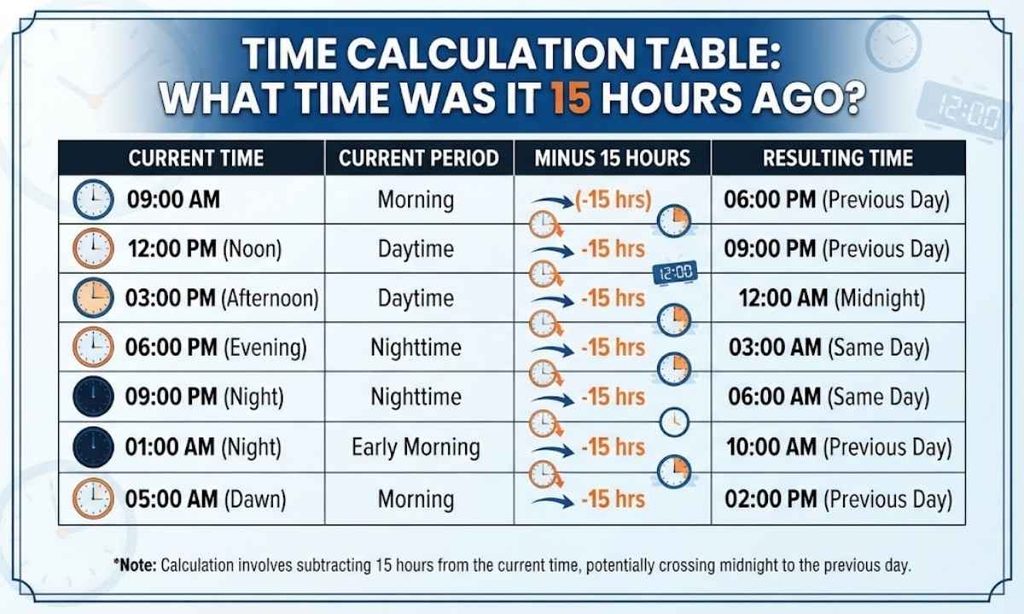
Here’s a full reference table showing 15 hours ago from various starting points throughout the day.
| Current Time (Today) | Time 15 Hours Ago | Day Shift |
| 12:00 AM (Midnight) | 9:00 AM | Previous day |
| 3:00 AM | 12:00 PM (Noon) | Previous day |
| 6:00 AM | 3:00 PM | Previous day |
| 9:00 AM | 6:00 PM | Previous day |
| 12:00 PM (Noon) | 9:00 PM | Previous day |
| 3:00 PM | 12:00 AM (Midnight) | Same day |
| 6:00 PM | 3:00 AM | Same day |
| 9:00 PM | 6:00 AM | Same day |
| 11:59 PM | 8:59 AM | Same day |
Notice the pattern: any current time from midnight up to 2:59 PM pushes you back into the previous day. Anything from 3:00 PM onward keeps you on the same day. That’s because 15 hours equals a full day minus 9 hours, and 3:00 PM is exactly the tipping point.
Step-by-Step: How to Calculate 15 Hours Ago Manually
If you want to work this out yourself without a calculator or converter, follow these steps.
Step 1: Write down the current time in 24-hour format
Convert your current time to a 24-hour clock. So 3:00 PM becomes 15:00, and 9:00 AM stays 09:00.
Step 2: Subtract 15 from the hour value
Take the hour number and subtract 15. For 15:00, that gives you 0, which is midnight. For 09:00, that gives you -6.
Step 3: Handle negative results
If your answer is negative, add 24 to it and move the date back one day. So -6 becomes 18 (6:00 PM), and you subtract one day from today’s date.
Step 4: Convert back to 12-hour format if needed
Once you have your final hour, convert it back to standard AM/PM format if that’s what you’re used to reading.
Quick Formula Reference
| Formula Step | Example (Current time: 5:00 AM) |
| Convert to 24-hour | 05:00 |
| Subtract 15 | 05 – 15 = -10 |
| Add 24 (since negative) | -10 + 24 = 14 |
| Result | 14:00, which is 2:00 PM |
| Day adjustment | Previous day |
So if it’s 5:00 AM right now, 15 hours ago was 2:00 PM yesterday.
Real-World Examples: Applying This to Everyday Situations
Numbers on a page are one thing. Here’s how this calculation actually shows up in daily life.
Scenario 1: Checking a flight departure Your flight lands at 6:00 AM local time and the flight duration was 15 hours. That means you boarded at 3:00 PM the day before. This is the exact math airlines use when they list departure and arrival times across time zones.
Scenario 2: Reviewing server or app logs You’re a developer looking at a timestamp that says an error occurred “15 hours ago” relative to a log pulled at 11:00 AM. That error actually happened at 8:00 PM the previous day.
Scenario 3: Coordinating with someone in a different time zone Someone tells you they sent a message 15 hours ago and it’s currently 8:00 AM where you are. They sent it at 5:00 PM your time yesterday, though remember, if they’re in a different time zone, you’d still need to adjust for that offset separately.
Scenario 4: Tracking medication or dosage timing If a dose needs to be taken every 15 hours and it’s currently 1:00 PM, the previous dose was at 10:00 PM the night before.
Common Mistakes and Misconceptions
People trip up on this calculation more often than you’d expect. Here are the mistakes worth watching for.
- Forgetting the day changes. The most common error is subtracting the hours correctly but leaving the date on “today” when it should roll back to “yesterday.”
- Mixing up AM and PM. When you cross midnight, it’s easy to accidentally keep the same AM/PM label instead of flipping it.
- Confusing “15 hours ago” with “15 hours from now.” These are opposite directions on the timeline, and the math looks similar enough to cause mix-ups if you’re moving fast.
- Ignoring time zones in cross-region questions. If you’re comparing “15 hours ago” between two people in different zones, you need to convert to a shared reference point first, like UTC, before doing the subtraction.
- Rounding to the nearest hour without checking minutes. If your starting time isn’t on the hour, like 2:47 PM, you still need to subtract 15 hours from the full time, not just the hour digit.
ALSO READ THIS: How Long Until 2:00 PM? The Simple Way to Calculate Time Remaining
Why People Search “What Time Was It 15 Hours Ago”

This question shows up constantly in search because it’s genuinely useful in a handful of common situations:
- Figuring out when a notification, email, or text was actually sent
- Working backward from a “posted X hours ago” timestamp on social media
- Calculating shift schedules, especially for jobs with rotating or overnight shifts
- Verifying alibi or timeline details, whether for personal reasons or something more formal
- Planning travel and figuring out actual departure times from stated flight durations
- Tracking fasting windows, medication schedules, or workout recovery periods that run on a fixed-hour cycle
It’s a small calculation, but it saves people from opening a calculator app or doing awkward mental math under pressure.
Related Time Calculations You Might Also Need
Once you’ve got the 15-hour version down, these related calculations follow the exact same logic:
| Calculation | Quick Method |
| What time was it 12 hours ago? | Flip AM to PM or PM to AM, keep the same clock number |
| What time was it 24 hours ago? | Same exact time, previous day |
| What time was it 10 hours ago? | Subtract 10 from the 24-hour format |
| What time was it 20 hours ago? | Subtract 20, or add 4 hours and go back one day |
| What time will it be in 15 hours? | Add 15 instead of subtracting |
| What day was it 15 hours ago? | Use the same hour math, but track whether the date rolled back |
If you’re regularly doing these calculations, bookmarking a simple time-difference calculator can save you the manual steps altogether, especially for numbers that don’t divide evenly into 12 or 24.
Conclusion
Working out what time it was 15 hours ago comes down to one rule: subtract 15 from your current hour, and if you land on a negative number, add 24 and move back a day. Once you’ve run through it a couple of times, it becomes second nature. Use the tables above whenever you need a quick lookup, and remember to factor in time zones separately if you’re comparing times across different regions.
Frequently Asked Questions
What time was it 15 hours ago if it’s currently 4:00 PM?
15 hours before 4:00 PM is 1:00 AM the same day. Since 4:00 PM (16:00) is greater than 15, you stay on the current calendar day.
Does 15 hours ago always fall on the previous day?
No. It only falls on the previous day if your current time is earlier than 3:00 PM. From 3:00 PM onward, 15 hours ago lands on the same day.
How is this different from calculating 15 hours from now?
Calculating “15 hours ago” moves backward on the timeline by subtracting, while “15 hours from now” moves forward by adding. They use the same 15-hour gap but head in opposite directions, so the resulting times will almost never match.
Do I need to account for time zones when calculating hours ago?
Only if you’re comparing your local time to someone else’s local time in a different zone. If you’re just calculating within your own time zone, you don’t need any extra adjustment beyond the basic subtraction.
What’s the fastest way to calculate this without doing math by hand?
Use a 24-hour clock format and subtract 15 directly. If you land on a negative number, add 24 and move the date back one day. Alternatively, any online time-difference or date calculator can do this instantly if you’d rather skip the manual steps.

I’m Daniel James, creator of TimeCruzz. I share simple grammar tips and writing guides to help learners improve English skills quickly, clearly, and confidently through easy explanations and practical examples.