

By a productivity and time-management writer, 10+ years covering scheduling, planning tools, and everyday math shortcuts.
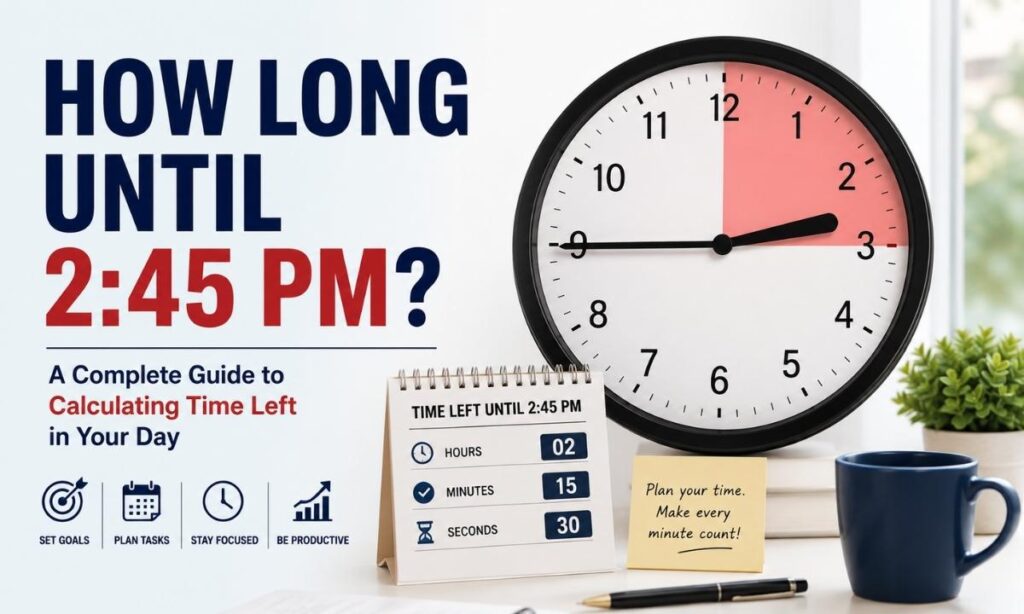
Quick summary: Trying to figure out how long until 2:45 PM? The answer depends entirely on what time it is right now. This guide walks you through the exact method to calculate it yourself in seconds, gives you ready-made reference tables for common starting times, and clears up the small mistakes people make when doing time math in their head.
Quick Answer
To find out how long until 2:45 PM, subtract your current time from 2:45 PM. If it’s already past 2:45 PM, you’re calculating how long until 2:45 PM tomorrow, which means you add the remaining hours in today plus the hours from midnight to 2:45 PM.
Here’s the shortcut most people forget: work in minutes first, then convert back to hours and minutes. It removes almost all the confusion that comes from mixing AM/PM and the 12-hour clock.
Example: If it’s 11:15 AM right now, you have 3 hours and 30 minutes left until 2:45 PM.
Why People Search “How Long Until 2:45 PM”
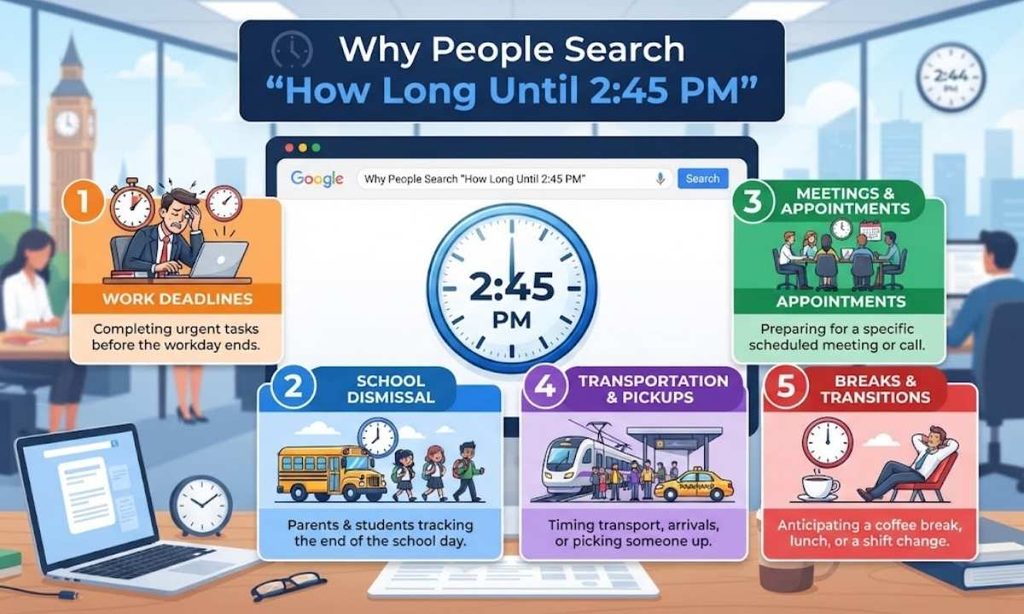
This isn’t a random query. People type this into Google for very specific, very human reasons:
- They have a meeting, flight, appointment, or exam scheduled for 2:45 PM and want to know how much time they have to prepare.
- They’re counting down to the end of a shift or a class period.
- A kid or student is trying to figure out how long until school lets out or a bus arrives.
- Someone set an alarm or reminder for 2:45 PM and wants a mental countdown.
- They’re doing quick math without wanting to pull out a calculator or open a new app.
The common thread is urgency. Nobody searches this out of idle curiosity they need a fast, accurate answer, which is exactly what the tables below are built for.
Step-by-Step: How to Calculate Time Until 2:45 PM
Here’s the method, broken into steps you can do in your head almost every time.
Step 1: Convert Both Times to 24-Hour Format
2:45 PM in 24-hour time is 14:45. Converting removes AM/PM confusion completely.
If your current time is in AM, keep it as-is (just drop the “AM”). If it’s PM, add 12 to the hour (except 12 PM, which stays 12).
Step 2: Subtract Current Time From 14:45
Line up hours and minutes separately:
- Subtract the hours.
- Subtract the minutes.
- If the minutes go negative, borrow 60 minutes from the hours column, the same way you’d borrow in regular subtraction.
Step 3: Handle the “Already Past 2:45 PM” Case
If your current time is later than 14:45, 2:45 PM has already happened today. In that case:
- Calculate the time remaining until midnight.
- Add the time from midnight to 2:45 PM (which is always 14 hours 45 minutes).
Step 4: Double-Check With Minutes
If you want a sanity check, convert everything into total minutes since midnight, subtract, then convert the result back into hours and minutes. This is the most error-proof method, especially for planning tools, spreadsheets, or scripts.
Formula:
Minutes until 2:45 PM = (14 × 60 + 45) − (current hour × 60 + current minute)
If the result is negative, add 1440 (the number of minutes in a full day) to get the time until 2:45 PM tomorrow.
Reference Table: Time Remaining From Common Starting Points
Here’s a ready-to-use table so you don’t have to do the math yourself for typical times of day.
| Current Time | Time Until 2:45 PM |
| 6:00 AM | 8 hours 45 minutes |
| 7:30 AM | 7 hours 15 minutes |
| 9:00 AM | 5 hours 45 minutes |
| 10:15 AM | 4 hours 30 minutes |
| 11:45 AM | 3 hours 0 minutes |
| 12:00 PM (Noon) | 2 hours 45 minutes |
| 1:00 PM | 1 hour 45 minutes |
| 1:30 PM | 1 hour 15 minutes |
| 2:00 PM | 45 minutes |
| 2:30 PM | 15 minutes |
| 2:44 PM | 1 minute |
| 2:45 PM | 0 minutes (it’s now) |
Reference Table: If It’s Already Past 2:45 PM
Since 2:45 PM only happens once per 24-hour cycle (unless you count both AM and PM versions), here’s what the countdown looks like once you’ve passed it today.
| Current Time | Time Until Next 2:45 PM |
| 3:00 PM | 23 hours 45 minutes |
| 6:00 PM | 20 hours 45 minutes |
| 9:00 PM | 17 hours 45 minutes |
| 11:59 PM | 14 hours 46 minutes |
| 12:00 AM (Midnight) | 14 hours 45 minutes |
| 3:00 AM | 11 hours 45 minutes |
| 6:00 AM | 8 hours 45 minutes |
Notice how, after midnight, the numbers match the top half of the first table. That’s because once you cross into a new day, you’re back to counting toward the same 2:45 PM target as before.
ALSO READ THIS: What Time Was It 15 Hours Ago? A Simple Guide to Calculating It Fast
Real-World Application Scenarios
Let’s put this into practice with situations people actually deal with.
Scenario 1: Catching an Afternoon Flight
Your flight boards at 2:45 PM and it’s currently 12:20 PM. You want to leave for the airport with buffer time.
- Time until 2:45 PM: 2 hours 25 minutes
- If your airport run takes 45 minutes and you want to arrive 90 minutes before boarding, you should leave by roughly 12:30 PM meaning you barely have time left at 12:20 PM.
Scenario 2: Countdown to a Work Meeting
It’s 1:52 PM and your meeting starts at 2:45 PM.
- Time remaining: 53 minutes
- Enough time to finish a task, grab coffee, and review your notes but not enough to start something long.
Scenario 3: School Pickup Planning
A parent needs to leave the house 20 minutes before a 2:45 PM pickup. It’s currently 1:40 PM.
- Time until 2:45 PM: 1 hour 5 minutes
- Subtract the 20-minute travel buffer: leave the house at 2:25 PM.
Scenario 4: Tracking a Live Event
A livestream starts at 2:45 PM and it’s 10:05 AM.
- Time remaining: 4 hours 40 minutes
- That’s roughly the length of a long car ride or half a workday useful context for planning what to do before it starts.
Common Mistakes People Make With This Calculation
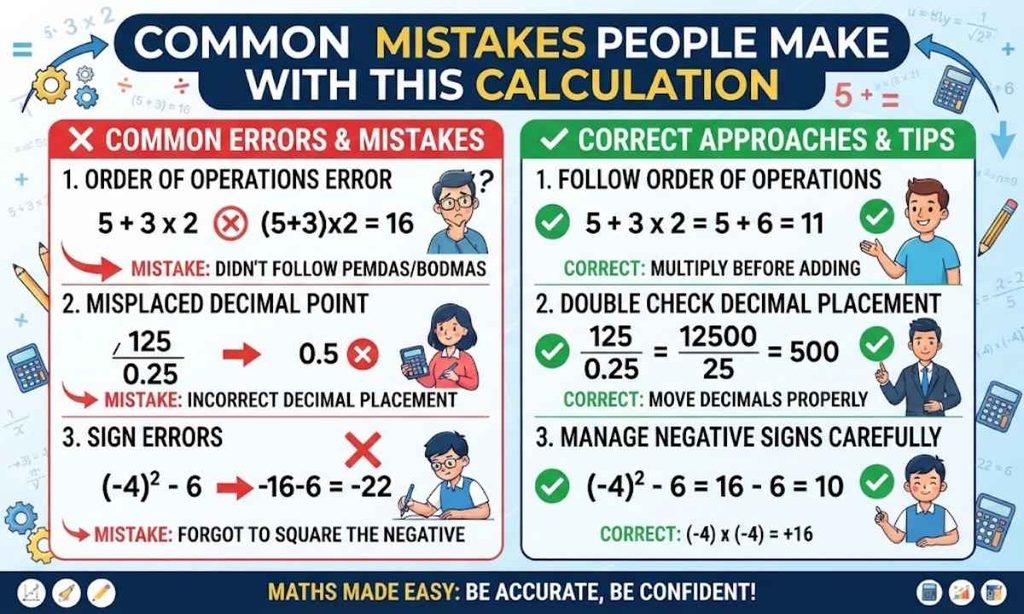
Time math looks simple, but small errors sneak in constantly. Here are the ones that trip people up most.
Forgetting to borrow minutes correctly. If you’re subtracting something like 2:15 minus 45 minutes, you can’t just subtract 45 from 15 and get a negative number and move on. You have to borrow an hour (60 minutes), turning 2:15 into 1:75, then subtract.
Mixing up AM and PM. This is the single biggest source of errors. Someone calculates the gap between “2:45” and their current time without realizing they’re comparing 2:45 AM instead of 2:45 PM. Always double-check which 2:45 you mean.
Ignoring the day rollover. If it’s currently 8:00 PM, you’re not counting down to a 2:45 PM that already happened you’re counting toward tomorrow’s 2:45 PM, which is nearly 19 hours away, not a negative number.
Rounding too early. If you round “2 hours 44 minutes” down to “2 hours 45 minutes” early in your calculation, small errors compound if you’re chaining multiple time calculations together (like planning a full day’s schedule).
Assuming 24-hour and 12-hour formats behave the same in subtraction. They don’t. Convert to 24-hour time first, especially if you’re building this into a spreadsheet formula or app.
Formula Conversion Reference
If you want to build this into a spreadsheet, script, or just want a cleaner mental model, here’s the breakdown.
| Conversion | Value |
| 2:45 PM in 24-hour time | 14:45 |
| 2:45 PM in total minutes since midnight | 885 minutes |
| Total minutes in a day | 1,440 minutes |
| Hours remaining in a day at 2:45 PM | 9 hours 15 minutes |
Spreadsheet-style formula (works in most tools):
= TIME(14,45,0) – NOW()
If the result is negative, add 1 (representing a full day) to roll it over to the next occurrence of 2:45 PM.
Related Calculations and Topics
If you found this useful, you’ll probably run into these related time questions too:
- How long until 3:00 PM a common one for people wrapping up a workday.
- How many hours between two clock times the general version of this same math.
- What time will it be in X hours the reverse calculation, adding instead of subtracting.
- Converting 12-hour to 24-hour time the core skill behind all of this.
- Countdown timers for specific events useful if you’d rather not do the math manually every time.
Understanding one of these makes the others much easier, since they all rely on the same subtraction-and-borrowing logic.
Conclusion
Figuring out how long until 2:45 PM comes down to one simple subtraction as long as you convert to 24-hour time first and handle the borrowing correctly when minutes go negative. Use the reference tables above for a quick lookup, or the formula if you’re plugging this into a spreadsheet or app. Once you’ve done the math a few times, you’ll be able to eyeball most of these gaps without even reaching for a calculator.
Frequently Asked Questions
How do I quickly calculate how long until 2:45 PM without a calculator?
Convert 2:45 PM to 24-hour time (14:45), then subtract your current time from it, borrowing 60 minutes from the hour column if the minutes go negative. For a rough estimate, just count the hours first and adjust for minutes after.
What if it’s already past 2:45 PM how do I find the time until tomorrow’s 2:45 PM?
Add the time remaining until midnight to 14 hours 45 minutes (the time from midnight to 2:45 PM). For example, at 8:00 PM, you have 4 hours until midnight plus 14 hours 45 minutes, totaling 18 hours 45 minutes.
Is 2:45 PM the same as 14:45 in 24-hour time?
Yes. Since 2:45 PM is in the afternoon, you add 12 to the hour to convert it: 2 + 12 = 14, so 2:45 PM equals 14:45 in 24-hour (military) time.
Can I set an automatic countdown to 2:45 PM on my phone?
Most phones let you set a specific alarm or timer for a clock time rather than a duration. Search your phone’s clock app for “alarm” and set it to 2:45 PM, or use a countdown timer app that accepts a target time instead of just a duration.
Why does my calculated time not match what my phone shows?
This usually happens because of time zone settings, daylight saving time changes, or your device rounding seconds. Double-check that your device’s clock and time zone are set correctly, and remember that manual calculations don’t account for seconds unless you specifically include them.

I’m Daniel James, creator of TimeCruzz. I share simple grammar tips and writing guides to help learners improve English skills quickly, clearly, and confidently through easy explanations and practical examples.