

Quick answer, no fluff: The time left until 1:20 depends entirely on what time it is right now. This guide walks you through the exact method to calculate it yourself, whether you’re counting down to 1:20 AM or 1:20 PM, plus every shortcut, table, and example you need to get the answer in seconds.
Search “how long until 1:20” and you’ll usually get a blank countdown page asking you to enter your timezone or refresh the browser. That’s not helpful when you just want a number. This post breaks down the actual math behind the question, so you can work it out on your own clock, your own phone, or in your head while you’re half asleep.
Quick Answer / Direct Verdict
To find out how long until 1:20, subtract your current time from 1:20 (either AM or PM, depending on which one you mean). If the current time is earlier than 1:20 today, just subtract directly. If 1:20 has already passed for today, you’re counting toward 1:20 tomorrow, so add 24 hours to your target before subtracting.
Here’s the formula in plain terms:
Time Until 1:20 = 1:20 (target) − Current Time
If that number comes out negative, add 24 hours and try again. That single rule handles almost every version of this question people search for.
Why People Search “How Long Until 1:20”
This phrase shows up for a handful of very different reasons, and it helps to know which one applies to you:
- Scheduling a call, meeting, or class that starts at 1:20 PM
- Setting an alarm or reminder for 1:20 AM, often for travel, medication, or a shift
- Tracking a countdown to an event listed with that exact start time
- Curiosity or a quick mental check while glancing at the clock
- Kids or students learning to read clocks and doing time-difference homework
Each of these needs the same basic math, just applied to a different context. A parent helping with a math worksheet needs the step-by-step version. Someone rushing to a 1:20 PM meeting just needs the number.
Step-by-Step: How to Calculate Time Until 1:20
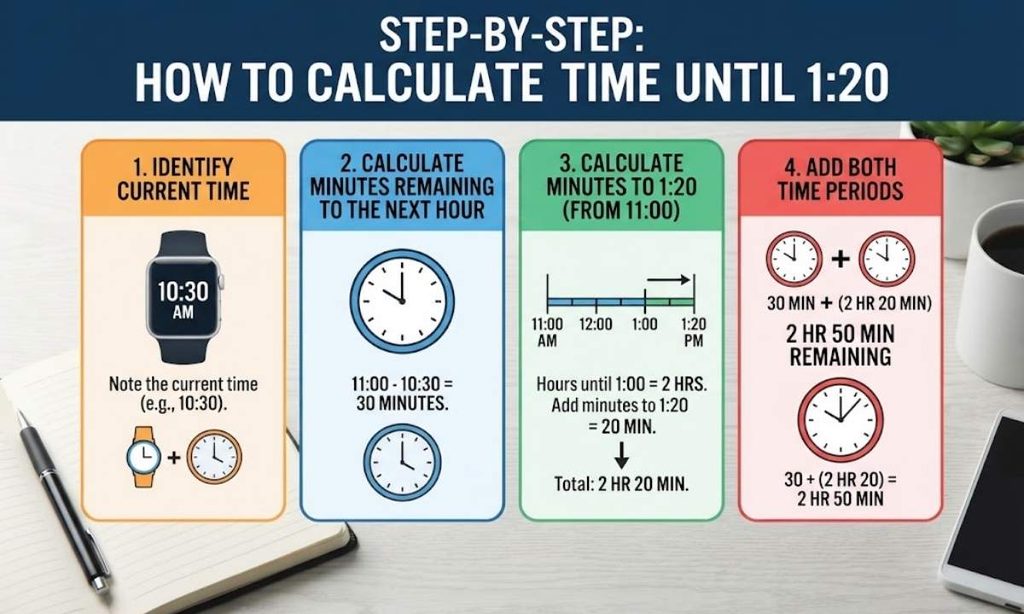
Here’s the process broken into steps you can repeat for any target time, not just 1:20.
Step 1: Confirm AM or PM
This sounds obvious, but it’s the most common mistake. “1:20” without a label could mean 1:20 in the early morning or 1:20 in the afternoon. Always nail this down first, especially if you’re working from a text message, calendar invite, or flight itinerary that dropped the AM/PM tag.
Step 2: Check the current time
Look at a clock you trust. Phones sync automatically, so that’s usually your most accurate source. Note the hour and minute.
Step 3: Convert both times to 24-hour format (optional but easier)
If math isn’t your strong suit, converting to 24-hour (military) time removes the AM/PM guesswork entirely.
- 1:20 AM becomes 01:20
- 1:20 PM becomes 13:20
ALSO READ THIS:How Long Until 7AM? A Simple Guide to Calculating Time Until Morning
Step 4: Subtract current time from target time
Line up the hours and minutes separately.
Example: It’s 10:45 AM, and you want to know how long until 1:20 PM.
- Convert 1:20 PM to 13:20
- Convert 10:45 AM to 10:45
- 13:20 − 10:45 = 2 hours and 35 minutes
Step 5: Handle the borrow (when minutes don’t subtract cleanly)
If the current minute is higher than the target minute, borrow an hour and add 60 to the minutes before subtracting. In the example above, 20 minutes is less than 45 minutes, so you’d borrow: 13:20 becomes 12:80, then 12:80 − 10:45 = 2 hours 35 minutes. Same answer, just showing the borrow step for anyone doing this by hand.
Step 6: If the target already passed, add 24 hours
Say it’s 3:00 PM and someone asks how long until 1:20 PM. That time already happened today. Add 24 hours to 13:20, making it 37:20, then subtract the current time (15:00): 37:20 − 15:00 = 22 hours and 20 minutes until 1:20 PM tomorrow.
Example Calculations Table
Here are common scenarios people run into, worked out so you can match your situation to the closest example.
| Current Time | Target Time | Time Remaining |
| 12:00 PM | 1:20 PM | 1 hour 20 minutes |
| 9:15 AM | 1:20 PM | 4 hours 5 minutes |
| 1:00 PM | 1:20 PM | 20 minutes |
| 1:25 PM | 1:20 PM (today, already passed) | 23 hours 55 minutes (until tomorrow) |
| 11:50 PM | 1:20 AM | 1 hour 30 minutes |
| 12:05 AM | 1:20 AM | 1 hour 15 minutes |
| 6:00 AM | 1:20 PM | 7 hours 20 minutes |
| 1:20 AM | 1:20 PM | 12 hours |
AM vs PM: Why the Distinction Changes Everything
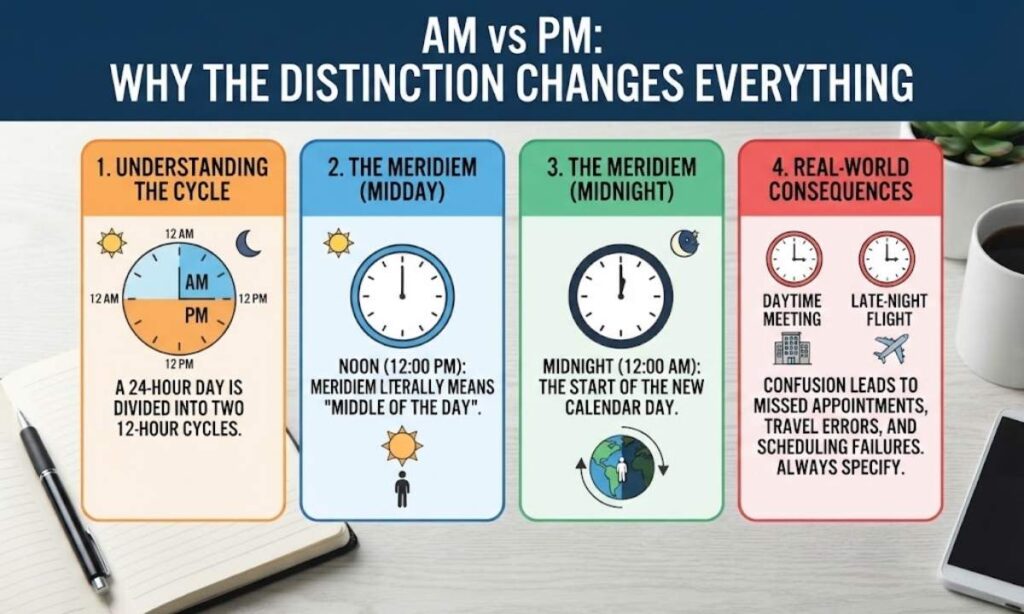
A lot of confusion around this question comes down to one missing letter. “1:20” by itself is ambiguous, and the gap between the two versions is huge.
| Scenario | Time Gap Type | Typical Use Case |
| Now is morning, target is 1:20 AM | Overnight countdown | Early flights, night shifts, medication timing |
| Now is morning, target is 1:20 PM | Same-day countdown | Lunch meetings, afternoon appointments |
| Now is evening, target is 1:20 AM | Short overnight wait | Late-night alarms, travel departures |
| Now is evening, target is 1:20 PM | Next-day countdown | Tomorrow’s schedule, event planning |
If you’re not sure which one applies to your search, picture where 1:20 sits on a 12-hour clock face and ask yourself: morning or afternoon-into-night? That usually settles it.
Common Mistakes People Make With This Calculation
Forgetting to check AM/PM
This is the single biggest source of wrong answers. Someone calculates the gap to 1:20 AM when they actually meant 1:20 PM, and the answer is off by twelve hours.
Subtracting minutes incorrectly
When the current minutes are higher than the target minutes, people often get a negative number and just flip the sign instead of borrowing an hour properly. That gives a wrong total every time.
Ignoring time zones
If you’re counting down to an event happening somewhere else, like a webinar listed in Eastern Time while you’re in Pacific Time, you need to convert first. Skipping this step is a common reason online countdowns feel “wrong.”
Assuming the target time is always in the future
If 1:20 already happened today and you don’t add the extra 24 hours, you’ll end up with a negative or nonsensical result.
Rounding too early
Rounding 4 hours 58 minutes down to “5 hours” might be fine for casual chat, but it throws off anything time-sensitive, like a countdown for a flight or a medication dose.
Real-World Application Scenarios
Catching a flight: If your boarding pass lists a 1:20 PM departure and it’s currently 9:40 AM, you have 3 hours and 40 minutes. Airlines typically recommend arriving 2 hours early for domestic flights, so you’d want to be at the gate area by roughly 11:20 AM at the latest.
Setting a wake-up alarm: If you need to be up by 1:20 AM for a red-eye and it’s currently 9:00 PM, that’s 4 hours and 20 minutes of time before your alarm goes off.
Joining a scheduled call: A meeting invite says 1:20 PM and your calendar shows 12:52 PM right now. That’s 28 minutes to wrap up whatever you’re doing and log in.
Homework or teaching clock math: Teachers often use 1:20 as a practice target because it forces students to deal with the “borrow a minute” step, since 20 doesn’t divide evenly against most starting times.
Related Calculations and Topics
Once you’ve got the method for 1:20 down, the same steps apply to any target time. A few related searches people run into:
- How long until 2:00 (a cleaner number, no borrowing needed)
- How long until noon or midnight (useful anchor points for quick mental math)
- Converting between 12-hour and 24-hour time formats
- Calculating time zone differences for remote meetings
- Working out elapsed time between two clock readings (the reverse of this problem)
If you found this useful, the exact same six-step process from earlier in this post works for literally any two clock times, not just 1:20.
Conclusion
Figuring out how long until 1:20 comes down to one simple subtraction, once you know whether you’re dealing with AM or PM and whether the time has already passed for today. Convert to 24-hour format if the math feels easier that way, remember to borrow an hour when the minutes don’t line up, and add a full day whenever your target time is already behind you. Once that clicks, you can run this calculation for any time on the clock, not just this one.
Frequently Asked Questions
How do I calculate how long until 1:20 PM from my current time?
Subtract your current time from 13:20 in 24-hour format. If your current time is later than 1:20 PM already, add 24 hours to the target before subtracting so you get the time until tomorrow’s 1:20 PM instead.
Is 1:20 in the morning or afternoon?
It can be either. Without an AM or PM label, 1:20 is ambiguous. Always check the source, like a calendar invite, itinerary, or message, to confirm which one is meant before doing the math.
What if 1:20 already happened today?
Add 24 hours to your target time and recalculate. This gives you the countdown to 1:20 tomorrow instead of a negative or confusing result.
How many minutes are there between now and 1:20?
Convert the full time gap into minutes by multiplying the hour difference by 60 and adding the leftover minutes. For example, 2 hours and 35 minutes equals 155 minutes total.
Does the answer change depending on my time zone?
Yes. If you’re counting down to an event tied to a specific time zone, like a livestream or flight listed in a different region’s local time, convert that target time to your own time zone first before subtracting.

I’m Daniel James, creator of TimeCruzz. I share simple grammar tips and writing guides to help learners improve English skills quickly, clearly, and confidently through easy explanations and practical examples.