
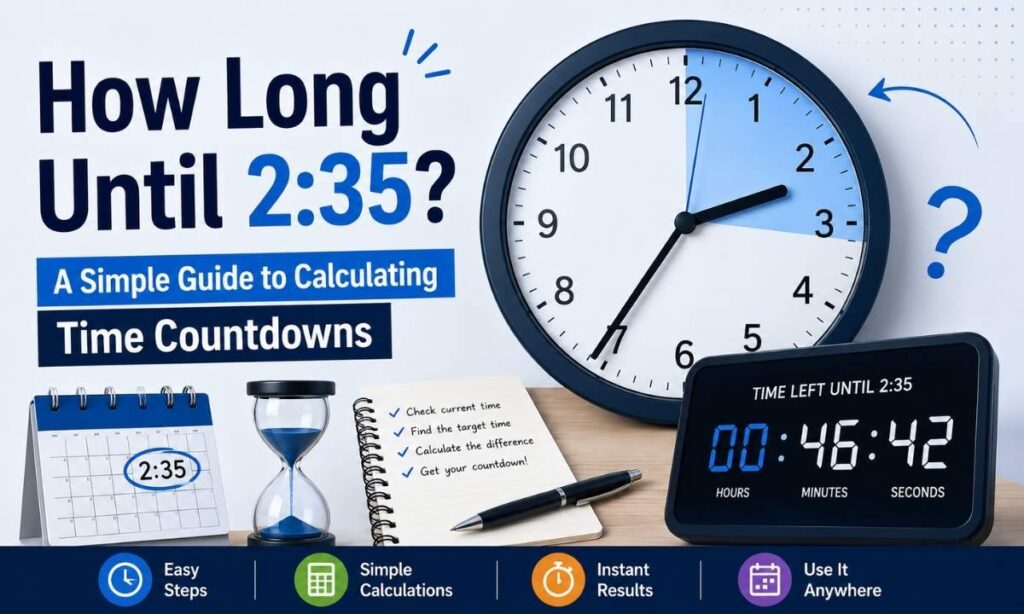

By a Content Strategist Who’s Answered This Question More Than Once Quick read: 7 minutes | Category: Time & Date Calculations
You glanced at the clock, saw a task or event scheduled for 2:35, and now you’re doing that mental math thing we all do. Is it minutes away? Hours? Are we talking 2:35 PM or 2:35 AM? This guide walks you through exactly how to figure out how long until 2:35, no matter what time it is right now when you’re reading this.
Quick Answer
The time remaining until 2:35 depends entirely on the current time when you’re checking. There’s no single fixed answer because “how long until 2:35” changes every minute of every day. Here’s the fast way to work it out:
- Subtract your current time from 2:35 (either 2:35 AM or 2:35 PM, depending on which one is coming next).
- If the current time has already passed 2:35 today, count forward to 2:35 the next day.
- Use minutes as your base unit for accuracy, then convert to hours and minutes for readability.
If you want an instant answer without doing the math yourself, typing “how long until 2:35” into Google or a countdown timer app will pull your device’s local clock and calculate it live. But understanding the logic behind it is genuinely useful, especially if you’re scheduling something manually, setting an alarm, or working across time zones.
Why People Search “How Long Until 2:35”
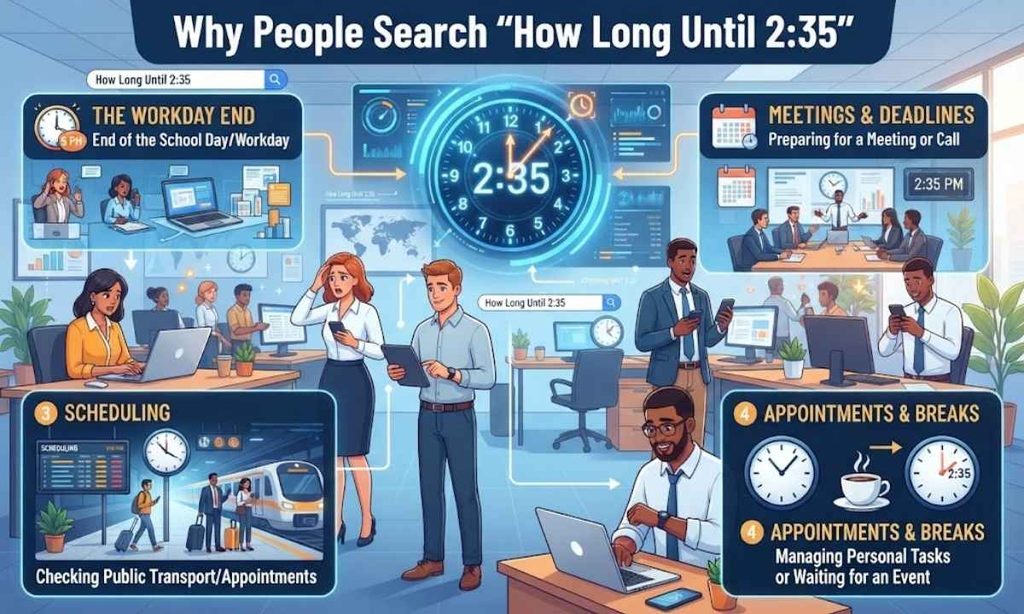
This is one of those oddly specific searches that pops up constantly, and there’s usually a real reason behind it. A few common ones:
- Alarm or reminder setting someone set an alarm for 2:35 (often 2:35 PM for a nap, meeting, or school pickup) and wants to know the wait time.
- Appointment countdowns doctor’s appointments, flights, or calls scheduled at 2:35 often trigger this exact search.
- Curiosity or boredom sometimes people just glance at a clock showing a time close to 2:35 and want to know how long until it hits.
- Games and streams livestreams, game servers, or events that go live at 2:35 generate a spike in this kind of search right before launch.
- Cross-timezone coordination someone in a different region trying to sync up with a 2:35 deadline elsewhere.
Search engines see this pattern with almost every specific time value “how long until 3:00,” “how long until 5:15,” and so on. It’s less about the number 2:35 itself and more about the human habit of counting down to something.
Step-by-Step: How to Calculate Time Until 2:35
Here’s the manual method, broken into simple steps. Grab your current time and follow along.
Step 1: Confirm AM or PM
First things first decide whether you mean 2:35 AM or 2:35 PM. This matters more than people expect, especially when using 24-hour clocks or scheduling tools that default to military time (14:35 for 2:35 PM).
Step 2: Convert Both Times to 24-Hour Format
Working in 24-hour format avoids confusion. Here’s the conversion:
| 12-Hour Time | 24-Hour Time |
| 2:35 AM | 02:35 |
| 2:35 PM | 14:35 |
Step 3: Subtract Current Time From Target Time
If your current time is earlier than 2:35 today, subtract directly.
Formula: Time Remaining = Target Time − Current Time
Step 4: If You’ve Already Passed 2:35, Add 24 Hours
If it’s already past 2:35 for the day (either AM or PM version, depending on which you meant), you’re counting toward tomorrow’s 2:35. Add 24 hours to your target time before subtracting.
Formula: Time Remaining = (Target Time + 24:00) − Current Time
Step 5: Convert Minutes Into Hours and Minutes
Once you have a raw number of minutes, divide by 60 to get hours, and keep the remainder as minutes.
Formula: Hours = Total Minutes ÷ 60 (rounded down) Minutes Remaining = Total Minutes mod 60
Worked Examples: How Long Until 2:35 PM
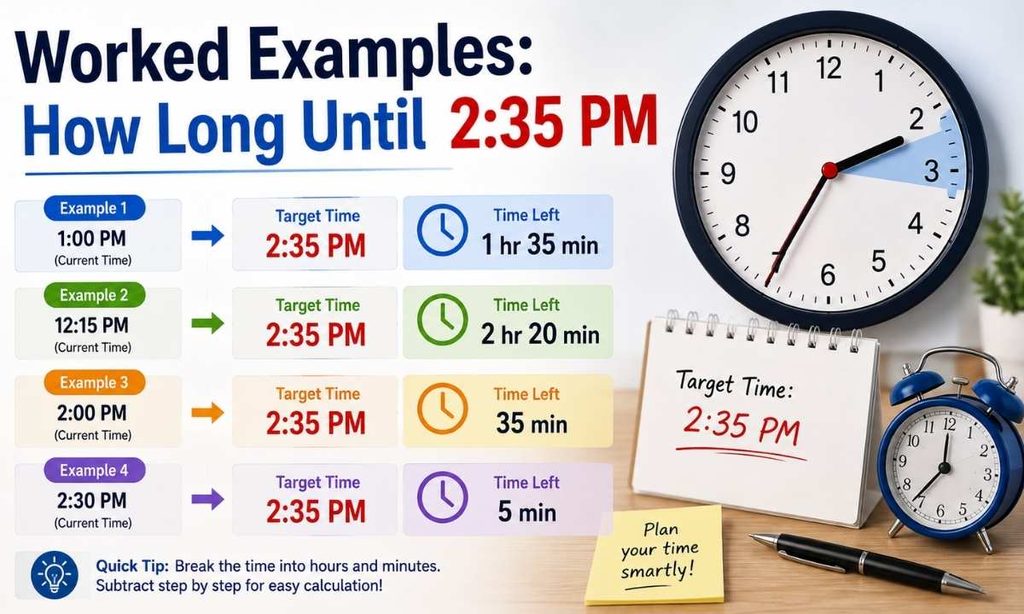
Let’s run a few real scenarios so the math clicks.
| Current Time | Target Time | Time Remaining |
| 9:00 AM | 2:35 PM | 5 hours 35 minutes |
| 12:15 PM | 2:35 PM | 2 hours 20 minutes |
| 1:50 PM | 2:35 PM | 45 minutes |
| 2:30 PM | 2:35 PM | 5 minutes |
| 3:00 PM | 2:35 PM (next day) | 23 hours 35 minutes |
| 11:59 PM | 2:35 PM (next day) | 14 hours 36 minutes |
Worked Examples: How Long Until 2:35 AM
Same logic applies for the early-morning version.
| Current Time | Target Time | Time Remaining |
| 10:00 PM | 2:35 AM | 4 hours 35 minutes |
| 12:00 AM (midnight) | 2:35 AM | 2 hours 35 minutes |
| 2:00 AM | 2:35 AM | 35 minutes |
| 2:40 AM | 2:35 AM (next day) | 23 hours 55 minutes |
| 6:00 AM | 2:35 AM (next day) | 20 hours 35 minutes |
A Faster Shortcut: Counting on the Hour
If math on paper isn’t your thing, try this trick instead of full subtraction:
- Round up to the next full hour from your current time.
- Note how many minutes that took.
- Count the remaining full hours to your target time.
- Add the leftover minutes (35, since your target is X:35) to the total.
Example: It’s 11:20 AM, and you want to know how long until 2:35 PM.
- From 11:20 to 12:00 = 40 minutes
- From 12:00 to 2:00 PM = 2 hours
- From 2:00 to 2:35 PM = 35 minutes
- Total = 2 hours + 40 minutes + 35 minutes = 3 hours 15 minutes
This method is handy when you’re doing the calculation in your head without a calculator or countdown app open.
Common Mistakes and Misconceptions
A few things trip people up when calculating countdowns to a specific time like 2:35.
- Mixing up AM and PM. This is the single biggest error. Always double-check which one applies before you calculate anything.
- Forgetting to roll over to the next day. If the current time is already past 2:35, you’re not counting “negative time” you’re counting toward tomorrow.
- Ignoring time zones. If you’re coordinating with someone in another region, “2:35” in your time zone isn’t the same moment as “2:35” in theirs. Always clarify which time zone the target refers to.
- Assuming daylight saving shifts don’t matter. During the clock change in spring or fall, a countdown that crosses that transition point can be off by an hour if you don’t account for it.
- Rounding too early. If you round minutes before finishing the calculation, small errors stack up. Do the full subtraction first, then round for display.
- Confusing 12-hour and 24-hour formats. 2:35 in 24-hour format is early morning (02:35), not afternoon. Written schedules, especially international ones, often use 24-hour time, so read carefully.
Real-World Scenarios Where This Matters
Setting a wake-up alarm. You go to bed at 10:45 PM and want to know how long you’ll actually sleep if your alarm is set for 2:35 AM (maybe for an early flight or shift). That’s 3 hours 50 minutes worth knowing before you commit to that alarm.
Joining a scheduled call or meeting. Meetings booked for 2:35 PM aren’t common, but they happen, especially when someone’s calendar is packed tight in 5-minute increments. Knowing you have “48 minutes” instead of vaguely “less than an hour” helps you plan the gap.
Live event or stream countdowns. Product launches, ticket drops, and game servers sometimes go live at oddly specific times to avoid overlapping with the top of the hour. A countdown app or manual calculation tells you exactly when to be ready.
Cooking or timed tasks. If a recipe or process needs to finish by 2:35, working backward from your current time tells you exactly how much runway you have left.
ALSO READ THIS: How Long Until 8PM? A Complete Guide to Counting Down the Hours
Related Time Calculations You Might Also Need
If you’re the type who searches “how long until 2:35,” chances are you’ll also want these:
- How long until 3:00 (or any top-of-the-hour time)
- How many hours between two specific clock times
- Time zone converters for coordinating across regions
- Countdown to a specific date (not just a time of day)
- Business hours calculators for figuring out working-day gaps
- Sunrise and sunset time calculators, often searched alongside early-morning countdowns
These all use the same core subtraction logic the trick is always converting to a consistent format (usually 24-hour time or total minutes) before doing the math.
Conclusion
“How long until 2:35” isn’t a question with one fixed answer it shifts by the minute, and it depends on whether you mean the early morning version or the afternoon one. Once you convert both times into a consistent format and subtract, the calculation takes seconds. Whether you’re setting an alarm, tracking a meeting, or just satisfying a random bit of curiosity, the method here works for any target time you throw at it, not just 2:35.
FAQs
How do I calculate how long until 2:35 without an app?
Convert both the current time and 2:35 into 24-hour format, then subtract the current time from the target time. If the target has already passed today, add 24 hours before subtracting.
Does “how long until 2:35” mean AM or PM?
It could be either. Most searches default to whichever 2:35 comes next from the current moment, but you should always confirm AM or PM based on your specific situation, especially for alarms and appointments.
What if it’s already past 2:35 today?
Then you’re counting toward 2:35 tomorrow. Add 24 hours to the target time, then subtract your current time from that total.
Why does this countdown change depending on when I check it?
Because it’s a moving target. “How long until 2:35” is calculated relative to your current time, so the answer is different every minute until it hits 2:35.
Can time zones affect the answer?
Yes. If the 2:35 deadline refers to a different region’s clock, you need to convert it to your local time zone first, or you’ll end up with a countdown that’s off by however many hours separate the two zones.

I’m Daniel James, creator of TimeCruzz. I share simple grammar tips and writing guides to help learners improve English skills quickly, clearly, and confidently through easy explanations and practical examples.