


Written by a content strategist who’s spent way too many late nights doing time math for deadlines, flights, and appointments.
You glanced at the clock, saw you need to be somewhere — or start something — at 2:40, and now you’re doing that mental math dance. Is it 2:40 AM or PM? How many hours and minutes stand between right now and then? This guide walks you through exactly how to figure out how long until 2:40, no matter what time it currently is, plus a few tools and tricks so you never have to count on your fingers again.
Quick Answer
The time remaining until 2:40 depends entirely on your current time. Here’s the simple formula:
Time until 2:40 = 2:40 (in 24-hour format) − Current time
If the result is negative, add 24 hours (meaning 2:40 has already passed today, so you’re counting toward tomorrow’s 2:40 instead). That’s it. The rest of this article breaks down exactly how to apply that formula in real situations, whether you mean 2:40 AM or 2:40 PM.
Why This Calculation Trips People Up
Time math feels like it should be easy, but three things usually cause confusion:
- AM vs PM ambiguity — “2:40” alone doesn’t tell you which half of the day you mean.
- Crossing the hour mark — subtracting minutes when the current minute is higher than 40 forces you to borrow an hour, which is where most manual mistakes happen.
- 24-hour vs 12-hour format — if you’re used to a 12-hour clock, converting to 24-hour time for calculation purposes adds an extra step people often skip or get wrong.
Once you separate these three issues, the actual subtraction is basic arithmetic.
Step-by-Step: How to Calculate Time Until 2:40
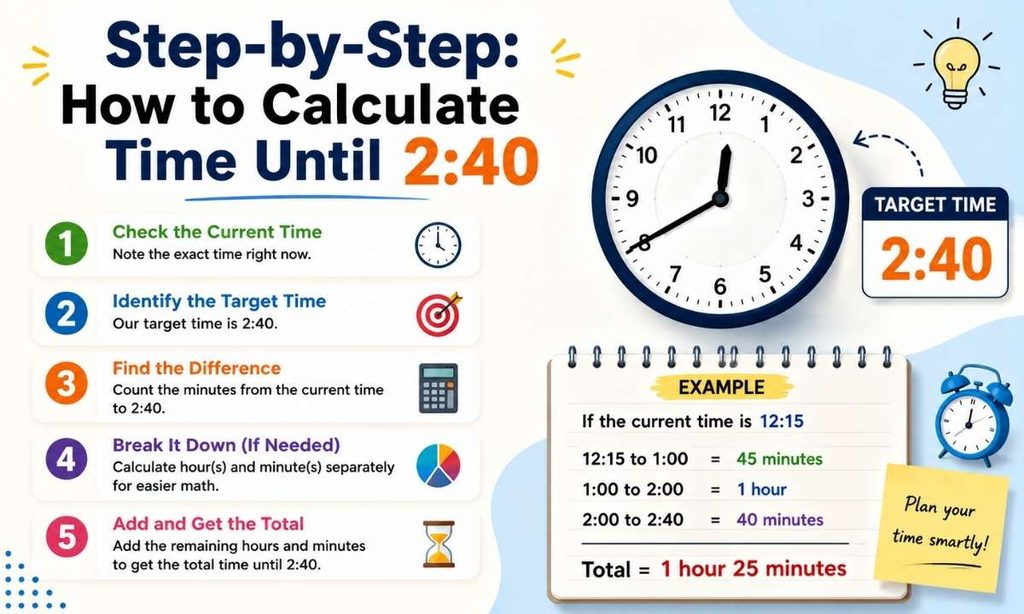
Follow this process every time, and you’ll never second-guess yourself.
Step 1: Confirm AM or PM
Decide whether you’re targeting 2:40 AM or 2:40 PM. This changes everything, so don’t skip it.
Step 2: Convert to 24-Hour Time
- 2:40 AM stays as 02:40
- 2:40 PM becomes 14:40
Step 3: Note Your Current Time in 24-Hour Format
Check your clock and convert it too. For example, 9:15 AM is 09:15, and 6:05 PM is 18:05.
Step 4: Subtract
Subtract your current time from the target time (02:40 or 14:40). If your current minutes are higher than 40, borrow 60 minutes from the hour column before subtracting.
Step 5: Handle a Negative Result
If subtracting gives you a negative number, it means the target time already passed today. Add 24:00 to get the time remaining until 2:40 tomorrow instead.
Worked Examples: Time Until 2:40 PM
Here’s a table showing exactly how much time is left until 2:40 PM from various starting points during the day.
| Current Time | Time Until 2:40 PM |
| 8:00 AM | 6 hours 40 minutes |
| 9:30 AM | 5 hours 10 minutes |
| 11:15 AM | 3 hours 25 minutes |
| 12:00 PM (Noon) | 2 hours 40 minutes |
| 1:20 PM | 1 hour 20 minutes |
| 2:00 PM | 40 minutes |
| 2:35 PM | 5 minutes |
| 2:40 PM | 0 minutes (it’s now!) |
| 3:00 PM | 23 hours 40 minutes (until tomorrow) |
Worked Examples: Time Until 2:40 AM
If you’re counting toward 2:40 in the early morning instead, here’s how that plays out.
| Current Time | Time Until 2:40 AM |
| 9:00 PM | 5 hours 40 minutes |
| 10:45 PM | 3 hours 55 minutes |
| 12:00 AM (Midnight) | 2 hours 40 minutes |
| 1:10 AM | 1 hour 30 minutes |
| 2:00 AM | 40 minutes |
| 2:39 AM | 1 minute |
| 2:40 AM | 0 minutes (it’s now!) |
| 3:15 AM | 23 hours 25 minutes (until tomorrow) |
Breaking Down the Math: Minutes, Hours, and Decimals
Sometimes you don’t just want hours and minutes — you want the total in one unit. Here’s how to convert.
| Format | Example (from 12:00 PM to 2:40 PM) |
| Hours and minutes | 2 hours 40 minutes |
| Total minutes | 160 minutes |
| Decimal hours | 2.67 hours |
| Seconds | 9,600 seconds |
To convert hours and minutes into decimal hours: divide the minutes by 60 and add to the hour count. So 2 hours 40 minutes becomes 2 + (40 ÷ 60) = 2.67 hours.
To convert into total minutes: multiply the hours by 60 and add the leftover minutes. So 2 hours 40 minutes = (2 × 60) + 40 = 160 minutes.
Real-World Scenarios Where This Matters
People search “how long until 2:40” for all kinds of practical reasons. A few common ones:
- Catching a train, bus, or flight scheduled to depart at 2:40.
- Joining a meeting or class that starts at 2:40 PM.
- Timing a nap, break, or workout so it wraps up right at 2:40.
- Cooking or baking, where a dish needs to come out of the oven at a specific time.
- Medication schedules, where doses need to be timed precisely.
- Countdown anticipation — sometimes people are just watching the clock for something exciting happening at 2:40, like a live stream or event start time.
In all of these cases, the underlying math is identical. Only the context changes.
Common Mistakes People Make

Even simple time math goes sideways sometimes. Watch out for these:
- Mixing up AM and PM. This is the single biggest source of errors. Always double-check which half of the day you’re targeting.
- Forgetting to borrow an hour. If your current time is, say, 2:15 and you’re calculating toward 2:40, that’s fine — but if it’s 3:15 heading toward 2:40 the next day, people often forget the borrowing step and miscalculate the minutes.
- Ignoring time zones. If you’re coordinating with someone in another region, “2:40” in your time zone isn’t 2:40 in theirs. Always clarify whose clock you’re using.
- Assuming a 12-hour clock works for calculation. It doesn’t, not directly. Convert to 24-hour format first, do the subtraction, then convert back if needed for readability.
- Forgetting daylight saving shifts. On the two days a year clocks shift, your “hours until” calculation can be off by exactly one hour if you don’t account for it.
Why People Search This Topic?
“How long until [specific time]” is one of those quick, everyday queries people type into a search bar dozens of times a year. It’s not complicated, but it’s the kind of thing your brain doesn’t want to work out manually when you’re rushing out the door or juggling a dozen other thoughts.
Search engines and countdown tools exist precisely because doing this math in your head, under time pressure, is more error-prone than it looks. A quick lookup beats a wrong guess, especially when a flight or meeting is on the line.
Tools You Can Use Instead of Manual Math
If you’d rather skip the arithmetic entirely, here are a few reliable options:
- Phone clock apps — most let you set a countdown timer directly to a clock time.
- Search engine time calculators — typing “time until [time]” into most search engines returns an instant live countdown.
- Spreadsheet formulas — in Excel or Google Sheets, subtracting two time-formatted cells gives you the difference instantly, and formatting the result as [h]:mm shows hours and minutes cleanly.
- World clock and countdown websites — useful when you’re coordinating across time zones.
Related Calculations You Might Also Need
Once you’ve got the hang of this, these related time calculations use the exact same logic:
- How long until a specific hour on the hour (like 3:00 or 5:00)
- How many hours between two arbitrary clock times
- Converting a countdown into decimal hours for payroll or billing purposes
- Calculating time zone differences alongside a countdown
- Working out elapsed time after an event instead of time remaining before one
Conclusion
Figuring out how long until 2:40 comes down to one clean formula: convert both times to 24-hour format, subtract your current time from the target, and adjust if the target has already passed. Once you nail down whether you mean AM or PM, the rest is straightforward subtraction. Whether you’re catching a flight, timing dinner, or just curious, you now have every method — manual, tabular, and tool-based — to get the answer in seconds.
Frequently Asked Questions
How do I know if “2:40” means AM or PM?
Context usually tells you — check your calendar invite, ticket, or schedule. If it’s genuinely unclear, assume the nearest upcoming occurrence, since that’s what most countdown tools default to.
How many minutes are there until 2:40 if it’s currently 1:15?
That’s 1 hour and 25 minutes, which equals 85 minutes total.
What if 2:40 already passed today — how do I calculate time until tomorrow’s 2:40?
Add 24 hours to your subtraction result. For example, if it’s currently 5:00 PM and you’re targeting 2:40 PM, you’d calculate 24:00 − 2:20 = 21 hours 40 minutes until tomorrow’s 2:40 PM.
Does daylight saving time affect the countdown to 2:40?
Yes, on the specific days clocks spring forward or fall back. If your countdown crosses that transition, add or subtract an hour depending on the direction of the shift.
Can I calculate this automatically without doing the math myself?
Yes. Most smartphone clocks, search engines, and spreadsheet apps can calculate the exact time remaining instantly if you enter your current time and the target time of 2:40.

I’m Daniel James, creator of TimeCruzz. I share simple grammar tips and writing guides to help learners improve English skills quickly, clearly, and confidently through easy explanations and practical examples.