
Written by a content writer who’s spent way too many afternoons watching the clock | Quick read: 7 minutes
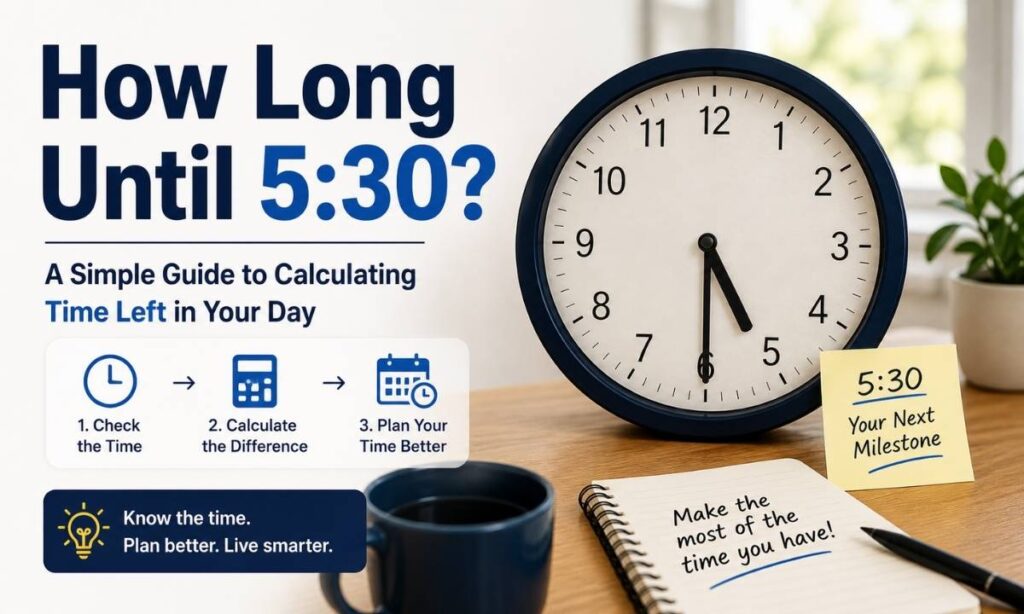
You glanced at the clock, saw the current time, and now you’re wondering exactly how long until 5:30. Maybe it’s quitting time. Maybe it’s when the kids get picked up, or when your favorite show starts, or when you promised to call someone back. Whatever the reason, you want a fast, accurate answer not a math lecture.
This guide breaks down exactly how to figure out how long until 5:30, whether you mean 5:30 AM or 5:30 PM, and gives you tables, formulas, and real examples so you never have to guess again.
Quick Answer
The time remaining until 5:30 depends entirely on what time it is right now. Here’s the shortcut:
- Subtract your current time from 5:30 (either AM or PM, whichever comes next).
- If the current time is already past 5:30 today, count forward to 5:30 the next day.
- Convert the leftover minutes into a clean hours-and-minutes format.
For example, if it’s currently 2:15 PM and you’re counting to 5:30 PM, you have 3 hours and 15 minutes left. If it’s 5:30 AM you’re aiming for and it’s currently 11:00 PM, you have 6 hours and 30 minutes to go.
There’s no single fixed answer because “how long until 5:30” is a moving target — it changes every second based on when you’re asking. But once you know the method, the math takes about five seconds.
Why This Question Comes Up So Often
People search “how long until 5:30” way more than you’d think, and it’s rarely about curiosity. It’s usually tied to something specific:
- Work shifts. A huge number of jobs end at 5:30 PM, so it’s one of the most common “countdown to quitting time” searches.
- School pickup or daycare cutoffs. Many after-school programs close right around 5:30.
- Appointments and reservations. Doctor’s offices, salons, and restaurants often schedule slots at 5:30.
- Sunrise and sunset planning. In a lot of regions, 5:30 AM or 5:30 PM lines up with dawn or dusk depending on the season, so people check it before heading out for a run or a flight.
- TV, streaming, or live event start times. Shows, sports broadcasts, and webinars love the 5:30 slot.
Basically, 5:30 sits at that in-between spot — not quite the top of the hour, not quite the bottom — that a lot of daily routines are built around. That’s why it gets searched constantly, even though the math behind it is genuinely simple once you see it laid out.
Step-by-Step: How to Calculate Time Until 5:30
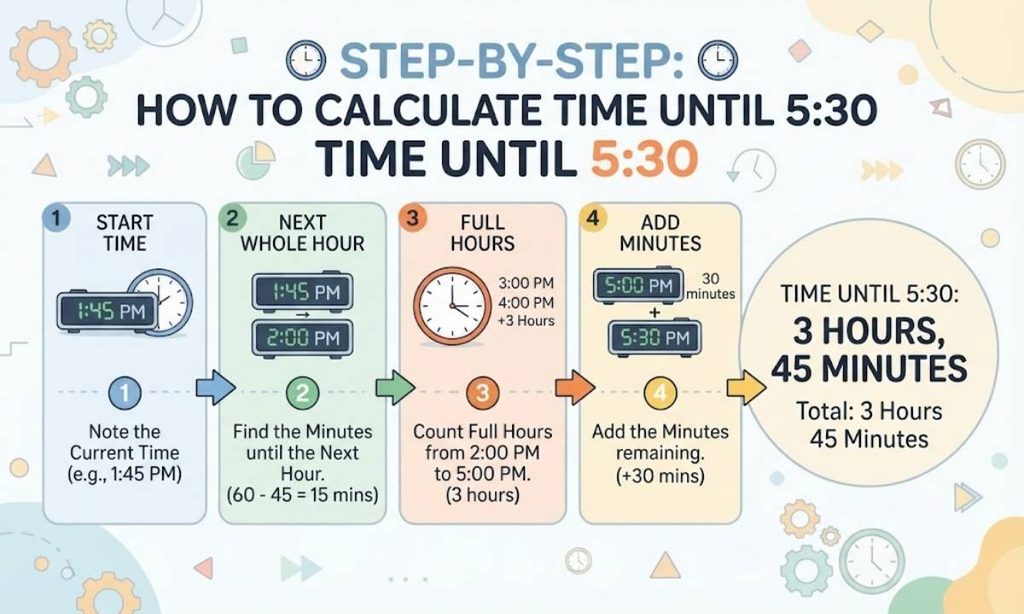
Here’s the method broken into steps you can run through in your head, no calculator needed.
Step 1: Identify the current time
Grab the actual time right now, down to the minute. Precision matters here — “around 2” isn’t going to give you an accurate countdown.
Step 2: Decide which 5:30 you mean
This trips people up more than anything else. There are two options:
- 5:30 AM — early morning
- 5:30 PM — late afternoon/early evening
If you don’t specify, most calculations default to the next upcoming 5:30, whichever one that happens to be.
Step 3: Subtract hours first, then minutes
Break the subtraction into two clean pieces instead of doing it all at once:
- Subtract the hour portion.
- Adjust the minutes separately.
- Combine them.
Step 4: Handle the “past midnight” cases
If the target time is earlier in the clock than right now (say it’s 8:00 PM and you’re counting to 5:30 AM), you’re counting into the next day. Add 24 hours to the target time before subtracting, or just count forward hour by hour until you land on it.
Step 5: Convert to a clean format
Round your final answer into hours and minutes (e.g., “4 hours, 12 minutes”) rather than a decimal like “4.2 hours.” It reads more naturally and matches how people actually think about time.
ALSO READ THIS: How Long Until 3:05? A Simple Guide to Calculating the Exact Time Left
Worked Examples: Time Until 5:30 PM
Here’s a table showing exactly how much time is left until 5:30 PM from a handful of common starting points.
| Current Time | Time Until 5:30 PM |
|---|---|
| 8:00 AM | 9 hours 30 minutes |
| 9:45 AM | 7 hours 45 minutes |
| 12:00 PM (Noon) | 5 hours 30 minutes |
| 1:20 PM | 4 hours 10 minutes |
| 3:00 PM | 2 hours 30 minutes |
| 4:15 PM | 1 hour 15 minutes |
| 5:00 PM | 30 minutes |
| 5:29 PM | 1 minute |
| 6:00 PM | 23 hours 30 minutes (next day) |
Worked Examples: Time Until 5:30 AM
If you’re counting toward early morning instead, here’s the equivalent breakdown.
| Current Time | Time Until 5:30 AM |
|---|---|
| 8:00 PM | 9 hours 30 minutes |
| 10:30 PM | 7 hours |
| 12:00 AM (Midnight) | 5 hours 30 minutes |
| 2:45 AM | 2 hours 45 minutes |
| 4:00 AM | 1 hour 30 minutes |
| 5:00 AM | 30 minutes |
| 5:25 AM | 5 minutes |
| 6:00 AM | 23 hours 30 minutes (next day) |
Converting Minutes to Decimal Hours (Bonus Formula)
Sometimes you need the answer in decimal form instead of “hours and minutes” — useful for spreadsheets, payroll calculations, or scheduling tools. Here’s the conversion formula:
Decimal Hours = Whole Hours + (Minutes ÷ 60)
A quick reference table:
| Minutes | Decimal Equivalent |
|---|---|
| 10 minutes | 0.17 hours |
| 15 minutes | 0.25 hours |
| 20 minutes | 0.33 hours |
| 30 minutes | 0.5 hours |
| 40 minutes | 0.67 hours |
| 45 minutes | 0.75 hours |
| 50 minutes | 0.83 hours |
So if your countdown lands on “3 hours and 45 minutes,” that converts to 3.75 hours — handy if you’re logging billable time or estimating a project deadline.
Common Mistakes People Make
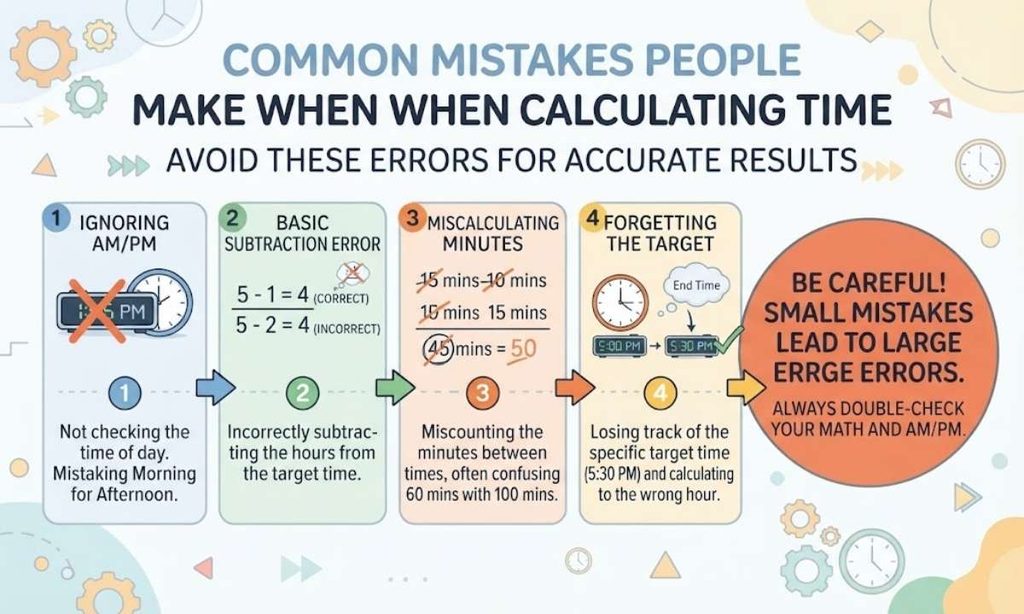
A few small errors show up constantly when people try to calculate this manually.
Mixing up AM and PM. This is the number one mistake. Someone means 5:30 PM but does the math against 5:30 AM, and the answer comes out wildly wrong — often off by 12 hours.
Forgetting to carry over minutes. If the current time has more minutes than the target (say it’s 3:50 and you’re aiming for 5:30), you can’t just subtract 50 from 30. You need to borrow an hour first: treat 5:30 as 4:90, then subtract normally.
Not accounting for the next day. If it’s already past 5:30 for the day you’re thinking of, the countdown rolls over. Skipping this step gives you a negative number, which obviously doesn’t make sense.
Ignoring time zones. If you’re coordinating a call or event with someone in a different time zone, “5:30” isn’t the same moment for both of you. Always clarify whose local time you’re using.
Rounding too early. Rounding 27 minutes up to “half an hour” might seem harmless, but it adds up over multiple calculations, especially in scheduling contexts where precision matters.
Real-World Scenarios Where This Matters
Countdown to end of work shift. If your workday wraps up at 5:30 PM, checking the time left helps you pace your last few tasks instead of scrambling at the last minute.
Catching a flight or train. If boarding closes at 5:30, knowing exactly how much cushion you have changes whether you grab coffee first or head straight to the gate.
Cooking and meal prep. Recipes with a hard finish time (dinner ready by 5:30) become much easier to plan backward from once you know your exact time buffer.
Fitness and running schedules. Early risers heading out before 5:30 AM sunrise often check this to time their warm-up and route length.
Live events and broadcasts. Whether it’s a webinar starting at 5:30 or a match kicking off then, a quick countdown keeps you from missing the opening minutes.
Related Calculations Worth Knowing
Once you’ve got the 5:30 countdown down, these related time calculations come in handy too:
- How long until 6:00 — the next full-hour milestone, often used for closing times.
- How long until midnight — useful for deadline-driven tasks.
- Elapsed time between two custom clock times — the general version of this same subtraction method.
- Converting 24-hour (military) time to standard time — helpful when working with international schedules or tech systems.
- Calculating time zone differences — essential once “5:30” needs to apply across regions.
Conclusion
Figuring out how long until 5:30 really comes down to one simple subtraction — the current time, subtracted from 5:30 AM or PM, with an adjustment if you’re already past it for the day. Once you know which 5:30 you’re targeting and get comfortable borrowing minutes when needed, you can do this math in your head in seconds. Use the tables above as a quick reference, and you’ll never have to stare at the clock doing mental gymnastics again.
FAQs
How long until 5:30 PM from right now?
It depends on the current time. Subtract your current hour and minute from 5:30 PM directly. For example, from 2:00 PM it’s 3 hours and 30 minutes; from 4:45 PM it’s 45 minutes.
How do I calculate how long until 5:30 AM?
Use the same subtraction method, but if it’s currently evening or nighttime, count forward past midnight. From 11:00 PM, for instance, it’s 6 hours and 30 minutes until 5:30 AM.
What if it’s already past 5:30 today?
Then you’re counting to 5:30 the next day. Add 24 hours to the target time before subtracting, which usually gives you a countdown somewhere close to 23 hours, depending on your current time.
Is there an easy way to calculate this without doing manual math?
Yes — most phones and computers have a built-in clock or countdown timer app where you can just set 5:30 as the target and let it calculate automatically. It’s faster and avoids the borrowing-minutes mistake entirely.
Does “how long until 5:30” change based on time zones?
Yes. 5:30 in one time zone isn’t the same moment as 5:30 in another. If you’re scheduling something across regions, always confirm whether you mean local time or a specific time zone’s 5:30.

I’m Daniel James, creator of TimeCruzz. I share simple grammar tips and writing guides to help learners improve English skills quickly, clearly, and confidently through easy explanations and practical examples.