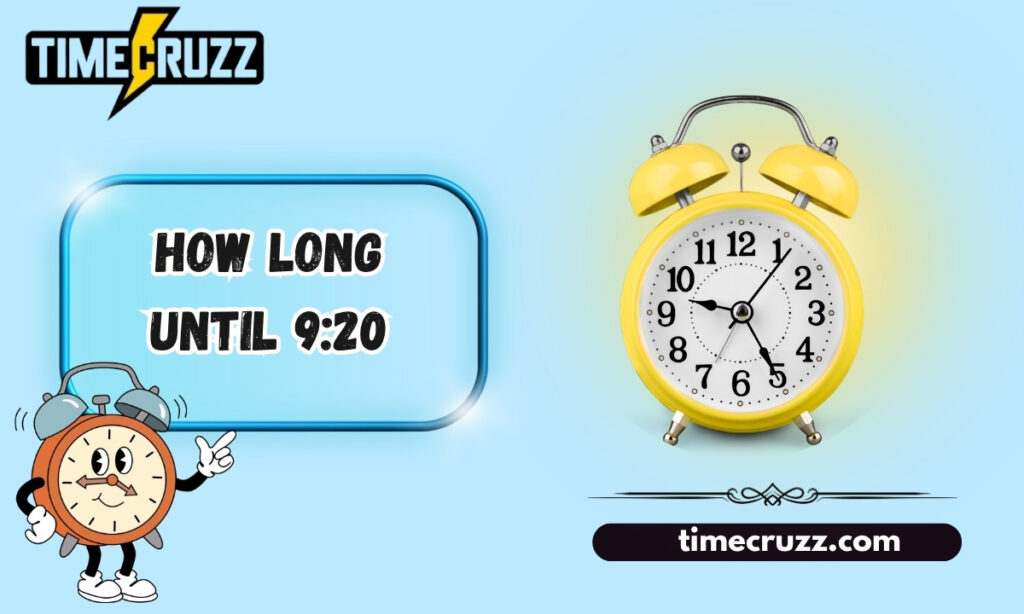

If you are wondering how long until 9:20, the answer depends on your current local time and whether you mean 9:20 AM or 9:20 PM. You can calculate the remaining hours and minutes by comparing the current time with your target time.
For example, if it is 8:00 AM, there are 1 hour and 20 minutes until 9:20 AM. If it is 8:00 PM, the same amount of time remains until 9:20 PM.
This guide explains how to calculate the time remaining, understand 9:20 in different clock formats, and plan your schedule without confusion.
Quick Answer: How Long Until 9:20?
There is no single fixed answer to how long until 9:20 because the countdown changes every minute. If 9:20 has not arrived today, subtract the current time from your target time. If it has already passed, count down to 9:20 tomorrow.
Here are some examples to help you understand the calculation.
| Current Time | Target Time | Time Remaining |
|---|---|---|
| 8:00 AM | 9:20 AM | 1 hour 20 minutes |
| 8:30 AM | 9:20 AM | 50 minutes |
| 9:00 AM | 9:20 AM | 20 minutes |
| 9:10 AM | 9:20 AM | 10 minutes |
| 8:00 PM | 9:20 PM | 1 hour 20 minutes |
| 9:00 PM | 9:20 PM | 20 minutes |
These examples assume the current time and target time fall on the same day.
Profile Summary Table
The following table provides the essential information about 9:20 in common time formats.
| Time Detail | Information |
|---|---|
| Target time | 9:20 |
| Morning format | 9:20 AM |
| Evening format | 9:20 PM |
| 24-hour morning format | 09:20 |
| 24-hour evening format | 21:20 |
| Military time for morning | 0920 |
| Military time for evening | 2120 |
| Minutes past midnight at 9:20 AM | 560 minutes |
| Minutes past midnight at 9:20 PM | 1,280 minutes |
| Main calculation | Current time compared with target time |
Remember that 9:20 AM means morning, while 9:20 PM means evening. The distinction matters when setting alarms, planning appointments, or calculating a deadline.
Read Time Chart : How Long Until 11:30
What Does 9:20 Mean?
The time 9:20 means twenty minutes after nine o’clock. It can refer to either morning or evening, depending on whether AM or PM is specified.
On an analog clock, the minute hand points to the number 4 because each number represents five minutes. The hour hand sits slightly past the number 9.
Here is how to read the time correctly.
- 9:20 AM: Twenty minutes after nine in the morning.
- 9:20 PM: Twenty minutes after nine in the evening.
- 09:20: The 24-hour clock format for 9:20 AM.
- 21:20: The 24-hour clock format for 9:20 PM.
When someone gives you a time without specifying AM or PM, check the context to determine which part of the day they mean.
How to Calculate the Time Until 9:20
You do not need a special calculator to work out the time remaining until 9:20. A simple subtraction method is enough when the target time is later on the same day.
Follow these steps to calculate the countdown accurately.
Step 1: Check the Current Time
Look at your phone, computer, watch, or another reliable clock. Make sure you know the correct local time and whether it is AM or PM.
For example, suppose your current time is 8:15 AM.
Step 2: Identify Your Target Time
Decide whether you want to reach 9:20 AM or 9:20 PM. This prevents mistakes when calculating a countdown that crosses from morning to evening or from one day to the next.
For this example, the target time is 9:20 AM.
Step 3: Subtract the Current Time
From 8:15 AM to 9:00 AM is 45 minutes. From 9:00 AM to 9:20 AM is another 20 minutes.
Add the two amounts together.
45 minutes + 20 minutes = 65 minutes.
Therefore, if the current time is 8:15 AM, there are 1 hour and 5 minutes until 9:20 AM.
Step 4: Check Whether the Target Has Passed
If it is already 9:30 AM, the target time of 9:20 AM has passed. If you mean the next occurrence of 9:20 AM, you must count down to the following morning.
This simple rule makes it easier to calculate time remaining for appointments, school schedules, work shifts, and personal reminders.
How Many Minutes Until 9:20?
The number of minutes remaining depends on the current time. To find the answer, calculate the difference between the current time and 9:20.
For example:
| Current Time | Minutes Until 9:20 |
|---|---|
| 8:20 | 60 minutes |
| 8:30 | 50 minutes |
| 8:40 | 40 minutes |
| 8:50 | 30 minutes |
| 9:00 | 20 minutes |
| 9:05 | 15 minutes |
| 9:10 | 10 minutes |
| 9:15 | 5 minutes |
| 9:19 | 1 minute |
The table applies when the current time and target time belong to the same AM or PM period.
If you are counting down to 9:20 PM, use the same method with the evening time. For instance, from 9:00 PM to 9:20 PM, only 20 minutes remain.
How Many Seconds Until 9:20?
You can also calculate the number of seconds remaining until 9:20. First, determine the total number of minutes remaining. Then multiply that number by 60.
For example, if there are 20 minutes until 9:20:
20 × 60 = 1,200 seconds.
If there are 10 minutes left, the calculation is:
10 × 60 = 600 seconds.
Here is a quick reference table.
| Minutes Remaining | Seconds Remaining |
|---|---|
| 1 minute | 60 seconds |
| 5 minutes | 300 seconds |
| 10 minutes | 600 seconds |
| 15 minutes | 900 seconds |
| 20 minutes | 1,200 seconds |
| 30 minutes | 1,800 seconds |
| 60 minutes | 3,600 seconds |
These figures are exact for the stated number of full minutes. For a live countdown that includes seconds, you also need to account for the seconds shown on your current clock.
Is 9:20 AM the Same as 09:20?
Yes. 9:20 AM and 09:20 represent the same time of day. The difference is the clock format being used.
The 12-hour clock uses AM and PM to distinguish morning from evening. The 24-hour clock uses numbers from 00:00 to 23:59, so it does not need these labels.
Here is a simple comparison.
| 12-Hour Clock | 24-Hour Clock | Part of the Day |
|---|---|---|
| 6:20 AM | 06:20 | Morning |
| 8:20 AM | 08:20 | Morning |
| 9:20 AM | 09:20 | Morning |
| 12:20 PM | 12:20 | Afternoon |
| 8:20 PM | 20:20 | Evening |
| 9:20 PM | 21:20 | Evening |
In the 24-hour format, morning times retain their hour numbers, with a leading zero used for single-digit hours. For evening times after noon, add 12 to the hour shown on the 12-hour clock, except for 12 PM.
Why Might You Need to Know How Long Until 9:20?
Knowing the time remaining until a specific hour can help you organize everyday activities. Whether you are waiting for an appointment or preparing for an important task, a countdown gives you a clear idea of how much time you have left.
Here are several common situations in which this calculation is useful.
Work and Meetings
If a meeting starts at 9:20 AM, calculating the remaining time helps you decide when to finish your current task, prepare your notes, and join the meeting.
For example, if it is 8:50 AM, you have 30 minutes to get ready.
School and Classes
Students can use a countdown to prepare for a class, examination, or school activity. Knowing how many minutes remain makes it easier to organize books, review notes, and arrive on time.
Travel and Appointments
If you have an appointment at 9:20, knowing the time remaining can help you estimate when to leave. Remember to account for travel time, traffic, parking, and other possible delays.
Personal Routines
A specific time can also be useful for exercise, cooking, taking a scheduled break, or completing household tasks. A countdown helps you manage the time available without repeatedly checking the clock.
Reminders and Deadlines
If you need to submit work or complete a task by 9:20, calculating the remaining time can help you prioritize the most important steps.
For important deadlines, consider setting an alarm a few minutes early rather than waiting until the exact target time.
Tips for Calculating Time Until 9:20 Accurately
Use these practical tips to avoid common countdown mistakes.
- Confirm AM or PM: Make sure you are counting down to the correct time of day.
- Use your local clock: Your current time zone affects the countdown when comparing times across different locations.
- Check whether the time has passed: If 9:20 has already occurred, decide whether you mean tomorrow’s 9:20 or a different date.
- Convert minutes carefully: One hour contains 60 minutes, not 100.
- Include seconds when necessary: For precise timing, account for the seconds displayed on your clock.
- Set an alarm: If you cannot afford to miss the target time, use your phone or another reliable alarm.
- Allow extra time: If the target is an appointment or meeting, plan for preparation and travel rather than focusing only on the countdown.
The most important point is to compare the correct current time with the correct target time. Once both are clear, the calculation is straightforward.
Conclusion
So, how long until 9:20? The answer changes according to your current local time and whether you mean 9:20 AM or 9:20 PM.
If it is 9:00, you have 20 minutes remaining. If it is 8:30, you have 50 minutes remaining. If the target time has already passed, count down to the next occurrence when appropriate.
You can calculate the difference using simple subtraction, convert the result into minutes or seconds, and set an alarm to avoid missing an important event. Always check your clock and confirm AM or PM for an accurate result.
Frequently Asked Questions
1. How long until 9:20 AM?
The time remaining depends on your current local time. For example, if it is 9:00 AM, there are 20 minutes until 9:20 AM.
2. How many minutes until 9:20 PM?
Subtract the current time from 9:20 PM. If it is 9:10 PM, there are 10 minutes remaining until 9:20 PM.
3. What time is 9:20 in military time?
9:20 AM is 0920, while 9:20 PM is 2120 in military time. Their standard 24-hour clock formats are 09:20 and 21:20, respectively.
4. How do I calculate the time until 9:20?
Check your current time, identify whether your target is 9:20 AM or 9:20 PM, and subtract the current time from the target. If that time has passed, count toward the next occurrence if that is what you need.
5. How many seconds are there in 20 minutes?
There are 1,200 seconds in 20 minutes because one minute contains 60 seconds. Multiply 20 by 60 to get the total.

I’m Daniel James, creator of TimeCruzz. I share simple grammar tips and writing guides to help learners improve English skills quickly, clearly, and confidently through easy explanations and practical examples.