
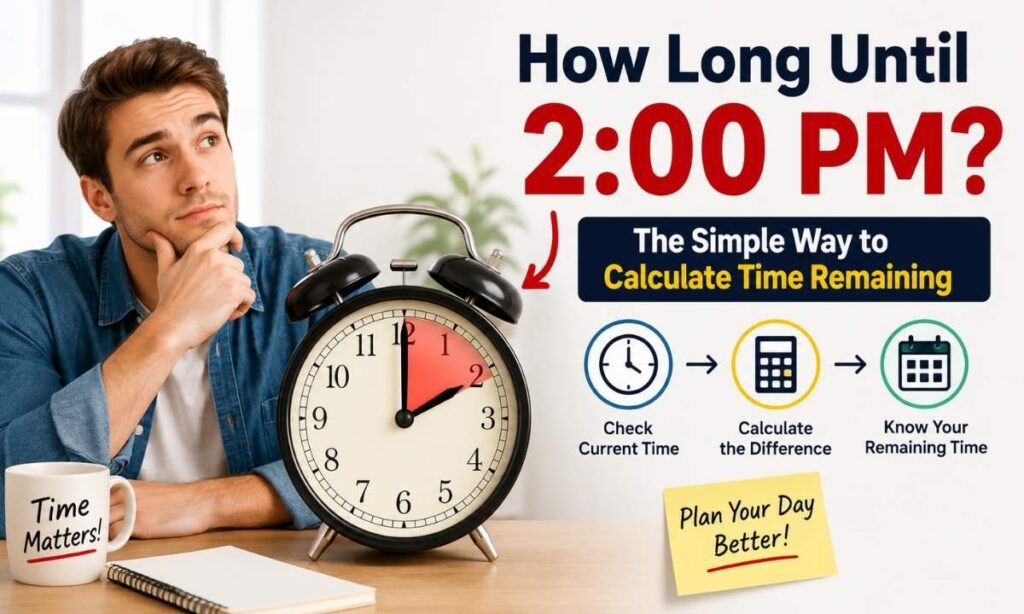

Quick read: This guide breaks down exactly how to figure out how long until 2:00 PM from any starting point in your day, with tables, formulas, and real-life examples so you never have to squint at a clock and do mental math again.
If you’ve ever glanced at your phone mid-morning and thought “how long until 2:00 PM?” you’re not alone. It’s one of those small, oddly specific questions that pops up constantly: before a meeting, before lunch ends, before a flight boards, before a shift starts. The answer changes every single time you ask it, because it depends entirely on what time it is right now.
This post walks through the actual math, gives you shortcuts for doing it in your head, and covers the common mix-ups that trip people up (looking at you, AM/PM confusion).
Quick Answer
There’s no single fixed answer to “how long until 2:00 PM” because it depends on your current time. But the calculation is always the same:
Time until 2:00 PM = 14:00 (in 24-hour format) minus your current time.
For example:
- If it’s 11:00 AM, you have 3 hours until 2:00 PM.
- If it’s 1:15 PM, you have 45 minutes until 2:00 PM.
- If it’s 2:00 PM already, the countdown is zero you’re there.
- If it’s 3:00 PM, you’ve already passed 2:00 PM by an hour (so you’d be counting toward tomorrow’s 2:00 PM, which is 23 hours away).
That’s the whole trick: convert everything to 24-hour time, then subtract.
Why People Search “How Long Until 2:00 PM”

This might seem like an oddly specific question, but it comes up more than you’d think. Here’s why people actually type this into Google:
- Work shifts a lot of retail, healthcare, and hospitality shifts start or end at 2:00 PM.
- School and college schedules afternoon classes, dismissal times, or exam start times often land near 2 PM.
- Meetings and calls “the call is at 2, how much time do I have to prep?”
- Flights and appointments boarding times, doctor’s appointments, and reservations.
- Fasting or diet windows intermittent fasting plans often use 2:00 PM as a cutoff or a “feeding window” marker.
- Countdown curiosity sometimes people just want a fast answer without doing the subtraction themselves, especially when they’re tired, distracted, or doing something else with their hands.
Basically, 2:00 PM is a common “anchor point” in daily schedules, so the question comes up constantly across totally different contexts.
Step-by-Step: How to Calculate Time Until 2:00 PM
Here’s the process broken into simple steps. This works whether you’re doing it by hand, in your head, or explaining it to someone else.
Step 1: Convert 2:00 PM to 24-hour time
2:00 PM = 14:00. Keep this number in your head it’s your target.
Step 2: Convert your current time to 24-hour format (if it’s PM)
If your current time is AM, leave it as-is. If it’s PM (and not 12), add 12.
Example: 1:30 PM → 13:30
Step 3: Subtract current time from 14:00
- Subtract the hours first.
- Then subtract the minutes.
- If minutes go negative, borrow an hour (subtract 1 from the hour result, add 60 to the minutes).
Example: Current time: 11:42 AM (which is 11:42 in 24-hour time)
14:00 − 11:42
- Hours: 14 − 11 = 3
- Minutes: 00 − 42 = negative, so borrow: 2 hours, and 60 − 42 = 18 minutes
Answer: 2 hours and 18 minutes until 2:00 PM.
Step 4: If the current time is after 14:00, calculate for the next day
If it’s already past 2:00 PM, you’re counting toward tomorrow’s 2:00 PM. Take 24:00, subtract your current time, then add 14 hours.
Example: Current time: 6:20 PM (18:20)
24:00 − 18:20 = 5 hours 40 minutes (time until midnight) 5 hours 40 minutes + 14 hours = 19 hours 40 minutes until 2:00 PM tomorrow.
Time Remaining Until 2:00 PM Quick Reference Table
Here’s a handy table for common starting times, so you don’t have to do the math yourself every time.
| Current Time | Time Until 2:00 PM |
| 6:00 AM | 8 hours |
| 7:00 AM | 7 hours |
| 8:00 AM | 6 hours |
| 9:00 AM | 5 hours |
| 9:30 AM | 4 hours 30 minutes |
| 10:00 AM | 4 hours |
| 10:45 AM | 3 hours 15 minutes |
| 11:00 AM | 3 hours |
| 12:00 PM (Noon) | 2 hours |
| 12:30 PM | 1 hour 30 minutes |
| 1:00 PM | 1 hour |
| 1:15 PM | 45 minutes |
| 1:30 PM | 30 minutes |
| 1:45 PM | 15 minutes |
| 1:55 PM | 5 minutes |
| 2:00 PM | 0 minutes (you’re here) |
What If It’s Already Past 2:00 PM?
This trips a lot of people up. If the current time is after 2:00 PM, “how long until 2:00 PM” almost always means tomorrow’s 2:00 PM, unless someone specifies otherwise. Here’s a table covering that scenario:
| Current Time (Today) | Time Until 2:00 PM (Tomorrow) |
| 2:30 PM | 23 hours 30 minutes |
| 4:00 PM | 22 hours |
| 6:00 PM | 20 hours |
| 8:00 PM | 18 hours |
| 10:00 PM | 16 hours |
| Midnight (12:00 AM) | 14 hours |
| 2:00 AM | 12 hours |
| 4:00 AM | 10 hours |
If you only care about “today,” and it’s already past 2:00 PM, the honest answer is: there’s no time left today. The window has closed.
Common Mistakes People Make With This Calculation

A few small errors show up again and again when people try to do this math on the fly:
1. Mixing up AM and PM This is the biggest one. Treating 2:00 AM and 2:00 PM as the same reference point throws the whole calculation off by 12 hours. Always double-check which one you actually mean.
2. Forgetting to convert to 24-hour time Subtracting “1:30 PM” directly from “2:00 PM” without converting can get confusing fast, especially once minutes are involved. Converting to 24-hour format first (13:30 and 14:00) removes the guesswork.
3. Not borrowing minutes correctly When the current minutes are higher than the target minutes (like 1:45 to 2:00, or worse, 11:50 to 2:00), people forget to borrow an hour and end up with a negative or nonsensical number.
4. Ignoring time zones If you’re calculating time until 2:00 PM for someone in a different time zone say, coordinating a call between New York and London you need to adjust for that first. “2:00 PM” only means something once you know whose 2:00 PM you’re talking about.
5. Forgetting daylight saving shifts Twice a year, the clocks jump forward or back. If your calculation happens to straddle that shift (rare, but it happens), the math won’t behave normally. Worth a mental flag if you’re doing overnight calculations near those dates.
ALSO READ THIS: How Long Until 3:00 PM? A Complete Guide to Calculating Time Countdowns
Real-World Scenarios
Scenario 1: Planning a lunch break It’s 12:15 PM and your team has a call scheduled for 2:00 PM. That gives you 1 hour and 45 minutes enough for lunch, a short walk, and a quick prep review before the call.
Scenario 2: Catching a flight Boarding closes at 2:00 PM and it’s currently 10:40 AM at the airport. You’ve got 3 hours and 20 minutes. Plenty of time for security, a coffee, and a slow walk to the gate.
Scenario 3: Intermittent fasting window Your eating window closes at 2:00 PM and it’s currently 1:50 PM. You’ve got 10 minutes to finish that last meal.
Scenario 4: End of a work shift Your shift ends at 2:00 PM, and it’s 9:15 AM. That’s 4 hours and 45 minutes left on the clock knowing the exact number can make a slow shift feel a little more manageable.
Related Calculations You Might Also Need
Since “how long until 2:00 PM” is really just one version of a broader time-math question, here are related calculations that follow the same logic:
| Question | How to Solve It |
| How long until 3:00 PM? | Same method subtract current time from 15:00 |
| How long until 5:00 PM? | Subtract current time from 17:00 |
| How long until midnight? | Subtract current time from 24:00 |
| How long until noon? | Subtract current time from 12:00 |
| How many hours between two times? | Convert both to 24-hour format, subtract earlier from later |
| How long ago was the past time? | Subtract past time from current time (result is elapsed time, not remaining time) |
Once you understand the 24-hour conversion trick, you can answer any “how long until X” question using the exact same steps.
Conclusion
“How long until 2:00 PM” isn’t a fixed number, it’s a moving target that depends entirely on what time it is right now. But the method to figure it out is dead simple once you convert everything to 24-hour time and subtract. Whether you’re counting down to a meeting, a flight, a shift, or the end of an eating window, the same three-step process works every time: convert, subtract, and borrow an hour if you need to. Bookmark the tables above, and you’ll never have to do the mental math cold again.
FAQs
How do I calculate how long until 2:00 PM from my current time?
Convert your current time to 24-hour format, then subtract it from 14:00 (which is 2:00 PM in 24-hour time). Subtract hours first, then minutes, borrowing an hour if the minutes go negative.
What if it’s already past 2:00 PM how long until the next one?
If it’s already past 2:00 PM today, you’re counting toward tomorrow’s 2:00 PM. Subtract your current time from 24:00, then add 14 hours to that result.
Is 2:00 PM the same as 14:00 in 24-hour time?
Yes. 2:00 PM converts directly to 14:00 in 24-hour (military) time, since you add 12 to any PM hour except 12:00 PM itself.
How many hours are there between 9:00 AM and 2:00 PM?
There are exactly 5 hours between 9:00 AM and 2:00 PM. This is a fixed gap, unlike a live countdown, since both times are specified.
Does this calculation change with time zones?
Yes. “2:00 PM” only refers to one specific moment once you know which time zone it’s in. If you’re coordinating across time zones, convert both times to the same zone before calculating the difference.

I’m Daniel James, creator of TimeCruzz. I share simple grammar tips and writing guides to help learners improve English skills quickly, clearly, and confidently through easy explanations and practical examples.